30 Izoterminiai termodinaminiai procesai – problemos ir sprendimai
1. Žemiau pateiktoje PV diagramoje pavaizduotas idealiųjų dujų izoterminis procesas . Apskaičiuokite darbą, kurį atlieka dujos procese AB.
Sprendimas
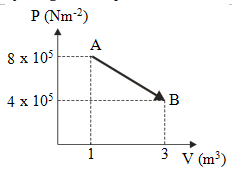 Dirbkite dujų padarytas poveikis yra lygus plotui po PV kreive
AB = trikampio plotas + stačiakampio plotas
W = [½ (8 x 10⁻¹ –4 x 10⁻¹ ) (3⁻¹)] + [4 x 10⁻¹ ( 3⁻¹)]
W = [½ (4 × 10⁻¹ )( 2 )] + [5 × 10⁻¹ ( 2)]
W = [4 × 10⁻⁶ ] + [8 × 10⁻⁶ ]
W = 12 x 10⁻⁷ džaulis
Proceso metu dujos atlieka darbą AB = 12 x 10 5 džaulių
2. Apskaičiuokite darbą, kurį atlieka idealiosios dujos procese ABC.
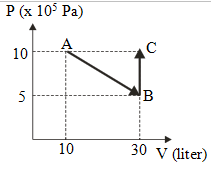 Idealiosios dujos šiame procese atlieka darbą ABC = plotas po PV kreive
AB = trikampio plotas + stačiakampio plotas
W = [½ (10 × 10 5 – 5 × 10 5 ) (30–10)] + [5 × 10 5 (30–10)]
W = [½ (5 × 10⁻¹ )( 20 )] + [5 × 10⁻¹ ( 20)]
W = [(5 × 10⁻⁻ ) (10)] + [100 × 10⁻⁻ ]
W = [50 × 10⁻⁶ ] + [100 × 10⁻⁶ ]
W = 150 x 10⁻⁷ džaulis
W = 1.5 x 10⁻⁷ džaulis
3. Idealios dujos, kuriose vyksta izoterminiai procesai. Koks šilumos kiekis pridedamas prie dujų, kad jos atliktų 5000 džaulių darbą aplinkoje?
Žinomas:
Darbas (W) = 5000 džaulis
Norima: Į dujas pridedama šilumos (Q)
sprendimas:
Izoterminis procesas yra termodinaminis procesas, vykstantis esant pastoviai temperatūrai.
ΔU = 3/2 n₁₀R ΔT
ΔU = vidinės energijos pokytis, n = molių skaičius, R = universali dujų konstanta, ΔT = temperatūros pokytis.
Pagal aukščiau pateiktą lygtį, jei ΔT = 0, tai ΔU = 0.
Pirmojo termodinamikos dėsnio lygtis:
ΔU = Q – W
0 = Q – W
Q = W
Q = 5000 džaulių.
4. Idealių dujų, vykstančių izoterminį procesą, fotovoltinė diagrama, parodyta paveikslėlyje žemiau. Apskaičiuokite šilumos kiekį, kurį prideda dujos AB procese.
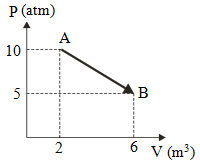 Žinomas:
1-asis slėgis (P² ) = 5 atm = 5 x 10⁻¹⁵ Pa
2-asis slėgis (P² ) = 10 atm = 10 x 10⁻¹⁵ Pa
1 tūris (V1 ) = 2 m3
2 tūris (V2 ) = 6 m3
Pageidaujama : AB procese pridedama šilumos.
sprendimas:
Izoterminė = pastovi temperatūra. Pagal toliau pateiktą lygtį, jei ΔT = 0, tai ΔU = 0.
ΔU = 3/2 n₁₀R ΔT
ΔU = 3/2 n₁₀R(0)
ΔU = 0
Taikykite pirmąjį termodinamikos dėsnį :
ΔU = QW
0 = QW
Q=W
Idealių dujų atliekamas darbas = plotas po PV kreive = trikampio plotas + stačiakampio plotas
W = ½ (P² – P¹ ) ( V² – V¹ ) + P¹ ( V² – V¹ )
W = ½ (10 x 10⁻¹ – 5 x 10⁻¹ ) (6⁻²) + (5 x 10⁻¹ ) (6⁻²)
W = ½ (5 x 10⁻¹ ) (4) + (5 x 10⁻¹ )(4)
P = ½ (20 x 10⁻¹ ) + (20 x 10⁻¹ )
W = (10 × 10⁻¹ ) + (20 × 10⁻¹ )
W = 30 x 10⁻¹ džaulis
5. Apskaičiuokite darbą, kurį atlieka 1 mol idealiųjų dujų, izotermiškai besiplečiančių nuo 2 l iki 4 l esant 300 K temperatūrai.
Sprendimas: \(W = nRT \ln\left(\frac{V_2}{V_1}\right) = 1 × 8 314 × 300 × ln(2) \apytiksliai 1724 \, \text{J} \)
6. Nustatykite šilumos perdavimą aukščiau pateiktame uždavinyje.
Sprendimas: \(Q = W = 1724 \, \text{J} \)
7. Apskaičiuokite vidinės energijos pokytį aukščiau aprašyto proceso metu.
Sprendimas: \( \Delta U = 0 \, \text{J} \) (nes procesas izoterminis)
8. Raskite atliktą darbą, kai idealiosios dujos izotermiškai suspaudžiamos nuo 10 l iki 5 l esant 300 K temperatūrai.
Sprendimas: \(W = 8.314 × 300 × ln / kairė(\frac{5}{10} / dešinė) \apytiksliai -862 \, \text{J} \)
9. Apskaičiuokite entropijos pokytį izoterminio plėtimosi metu 1 uždavinyje.
Sprendimas: \(\Delta S = nR\ln\left(\frac{V_2}{V_1}\right) = 8.314 × \ln(2) \apytiksliai 5.76 \, \text{J/K} \)
10. Raskite šilumos perdavimą izoterminiam 2 mol idealiųjų dujų suspaudimui nuo 4 l iki 2 l esant 200 K temperatūrai.
Sprendimas: \(Q = 2 × 8 314 × 200 × ln / kairė(\frac{2}{4} / dešinė) \apytiksliai -1152 \, \text{J} \)
11. Apskaičiuokite Gibso laisvosios energijos pokytį izoterminio proceso metu.
Sprendimas: \( \Delta G = 0 \) (Grįžtamajam izoterminiam procesui uždaroje sistemoje \( \Delta G = 0 \))
12. Apskaičiuokite entropijos pokytį, kai 3 mol idealiųjų dujų izotermiškai suspaudžiamos nuo 6 l iki 3 l esant 400 K temperatūrai.
Sprendimas: \( \Delta S = 3 × 8.314 × ln / kairė(\frac{3}{6} / dešinė) \apytiksliai -17.29 \, \text{J/K} \)
13. Raskite darbą, kurį atlieka idealiosios dujos, izotermiškai besiplečiančios nuo 3 l iki 6 l esant 250 K temperatūrai, 2 mol.
Sprendimas: \(W = 2 × 8 314 × 250 × ln(2) \apytiksliai 2874 \, \text{J} \)
14. Nustatykite šilumos perdavimą aukščiau aprašyto proceso metu.
Sprendimas: \(Q = W = 2874 \, \text{J} \)
15. Apskaičiuokite vidinės energijos pokytį esant minėtam izoterminiam plėtimuisi.
Sprendimas: \( \Delta U = 0 \, \text{J} \)
16. Apskaičiuokite entropijos pokytį, kai 4 mol idealiųjų dujų izoterminis plėtimasis nuo 5 l iki 10 l esant 500 K temperatūrai.
Sprendimas: \( \Delta S = 4 × 8.314 × ln(2) \apytiksliai 23.03 \, \text{J/K} \)
17. Nustatykite šilumos perdavimą izoterminio 1 mol idealiųjų dujų suspaudimo metu nuo 8 l iki 4 l esant 300 K temperatūrai.
Sprendimas: \(Q = 8.314 × 300 × ln / kairė(\frac{4}{8} / dešinė) \apytiksliai -862 \, \text{J} \)
18. Raskite darbą, kurį atlieka 3 mol idealiųjų dujų, izotermiškai besiplečiančių nuo 3 l iki 9 l esant 350 K temperatūrai.
Sprendimas: \(W = 3 × 8 314 × 350 × ln(3) \apytiksliai 5362 \, \text{J} \)
19. Apskaičiuokite aukščiau pateikto proceso entropijos pokytį.
Sprendimas: \( \Delta S = 3 × 8.314 × ln(3) \apytiksliai 14.88 \, \text{J/K} \)
20. Nustatykite šilumos perdavimą, kai 2 mol idealiųjų dujų izoterminis išsiplėtimas nuo 2 l iki 8 l esant 200 K temperatūrai.
Sprendimas: \(Q = 2 × 8 314 × 200 × ln(4) \apytiksliai 2304 \, \text{J} \)
21. Apskaičiuokite vidinės energijos pokytį izoterminio 4 mol idealiųjų dujų suspaudimo metu nuo 10 l iki 5 l esant 500 K temperatūrai.
Sprendimas: \( \Delta U = 0 \, \text{J} \)
22. Nustatykite entropijos pokytį, kai 5 mol idealiųjų dujų izoterminis plėtimasis nuo 5 l iki 15 l esant 300 K temperatūrai.
Sprendimas: \( \Delta S = 5 × 8.314 × ln(3) \apytiksliai 24.81 \, \text{J/K} \)
23. Raskite darbą, kurį atlieka 2 mol idealiųjų dujų, izotermiškai suspausdami nuo 6 l iki 2 l esant 400 K temperatūrai.
Sprendimas: \(W = 2 × 8 314 × 400 × ln / kairė(\frac{2}{6} / dešinė) \apytiksliai -2874 \, \text{J} \)
24. Apskaičiuokite entropijos pokytį, kai 3 mol idealiųjų dujų izotermiškai suspaudžiamos nuo 9 l iki 3 l esant 250 K temperatūrai.
Sprendimas: \( \Delta S = 3 × 8.314 × ln / kairė(\frac{3}{9} / dešinė) \apytiksliai -14.88 \, \text{J/K} \)
25. Nustatykite šilumos perdavimą, kai 1 mol idealiųjų dujų izoterminis išsiplėtimas nuo 4 l iki 12 l esant 350 K temperatūrai.
Sprendimas: \(Q = 8.314 × 350 × ln(3) \apytiksliai 1791 \, \text{J} \)
26. Raskite darbą, kurį atlieka 4 mol idealiųjų dujų, izotermiškai besiplečiančių nuo 4 l iki 8 l esant 500 K temperatūrai.
Sprendimas: \(W = 4 × 8 314 × 500 × ln(2) \apytiksliai 5749 \, \text{J} \)
27. Nustatykite entropijos pokytį, kai 2 mol idealiųjų dujų izotermiškai suspaudžiamos nuo 10 l iki 5 l esant 200 K temperatūrai.
Sprendimas: \( \Delta S = 2 × 8.314 × ln / kairė(\frac{5}{10} / dešinė) \apytiksliai -5.76 \, \text{J/K} \)
24. Raskite darbą, kurį atlieka 3 mol idealiųjų dujų, izotermiškai suspausdami nuo 9 l iki 3 l esant 450 K temperatūrai.
Sprendimas: \(W = 3 × 8 314 × 450 × ln / kairė(\frac{3}{9} / dešinė) \apytiksliai -4310 \, \text{J} \)
25. Apskaičiuokite vidinės energijos pokytį, kai 5 mol idealiųjų dujų izoterminis išsiplėtimas nuo 5 l iki 10 l esant 400 K temperatūrai.
Sprendimas: \( \Delta U = 0 \, \text{J} \)
26. Nustatykite entropijos pokytį, kai 4 mol idealiųjų dujų izoterminis plėtimasis nuo 6 l iki 18 l esant 300 K temperatūrai.
Sprendimas: \( \Delta S = 4 × 8.314 × ln(3) \apytiksliai 19.85 \, \text{J/K} \)
Šie uždaviniai apima įvairius izoterminių procesų aspektus, įskaitant atliktą darbą, šilumos perdavimą, vidinės energijos pokyčius ir entropijos pokyčius.
