Gerakan rotasi - masalah lan solusi
Torque
1. A beam 140 cm in length. There are three forces acts on the beam, F1 = 20 N, F2 = 10 N, and F3 = 40 N with direction and position as shown in the figure below. What is the torsi causes the beam rotates about the center of mass of the beam?
Dikenal: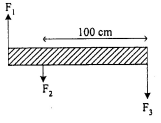
The center of mass located at the center of the beam.
Length of beam (l) = 140 cm = 1.4 meters
Kekuwatan 1 (F1) = 20 N, the lever arm 1 (l1) = 70 cm = 0.7 meter
Kekuwatan 2 (F2) = 10 N, the lever arm 2 (l2) = 100 cm – 70 cm = 30 cm = 0.3 meters
Kekuwatan 3 (F3) = 40 N, the lever arm 3 (l3) = 70 cm = 0.7 meter
Dikarepake: The magnitude of torque
Solusi:
The torque 1 rotates beam clockwise, so assigned a negative sign to the torque 1.
τ1 = F1 l1 = (20 N)(0.7 m) = -14 N m
The torque 2 rotates beam counterclockwise, so assigned a positive sign to the torque 2.
τ2 = F2 l2 = (10 N)(0.3 m) = 3 N m
The torque 3 rotates beam clockwise, so assigned a positive sign to the torque 3.
τ3 = F3 l3 = (40 N)(0.7 m) = -28 N m
The net torque :
Στ = -14 Nm + 3 Nm – 28 Nm = – 42 Nm + 3 Nm = -39 Nm
The magnitude of the torque is 39 N m. The direction of rotation of the beam clockwise, so assigned a negative sign.
2. What is the net torque acts on the beam The axis of rotation at point D. (sin 53o = 0.8)
Dikenal:
The axis of rotation at point D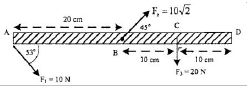
F1 = 10 N and l1 = r1 sin θ = (40 cm)(sin 53o) = (0.4 m)(0.8) = 0.32 meters
F2 = 10√2 N and l2 = r2 sin θ = (20 cm)(sin 45o) = (0.2 m)(0.5√2) = 0.1√2 meters
F3 = 20 N and l3 = r1 sin θ = (10 cm)(sin 90o) = (0.1 m)(1) = 0.1 meters
Dikarepake: The net torque
Solusi:
τ1 = F1 l1 = (10 N)(0.32 m) = 3.2 Nm
(The torque 1 rotates beam counterclockwise so we assign positive sign to the torque 1)
τ2 = F2 l2 = (10√2 N)( 0.1√2 m) = -2 Nm
(The torque 2 rotates beam clockwise so we assign negative sign to the torque 2)
τ3 = F2 l2 = (20 N)(0.1 m) = 2 Nm
(The torque 3 rotates beam counterclockwise so we assign positive sign to the torque 3)
The net torque :
Στ = τ1 – τ1 + τ3
Στ = 3.2 Nm – 2 Nm + 2 Nm
Στ = 3.2 Nm
3. What is the net torque if the axis of rotation at point D. (sin 53o = 0.8)
Dikenal:
The axis of rotation at point D.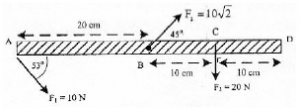
kadohan between F1 lan sumbu rotasi (rAD) = 40 cm = 0.4 m
Jarak antarane F2 lan sumbu rotasi (rBD) = 20 cm = 0.2 m
Jarak antarane F3 lan sumbu rotasi (rCD) = 10 cm = 0.1 m
F1 = 10 Newton
F2 = 10√2 Newton
F3 = 20 Newton
Dosa 53o = 0.8
Dikarepake: The net torque
Solusi:
The moment of the force 1
Στ1 = (F1)(rAD dosa 53o) = (10 N)(0.4 m)(0.8) = 3.2 Nm
(The torque 1 rotates beam counterclockwise so we assign positive sign to the torque 1)
The moment of the force 2
Στ2 = (F2)(rBD dosa 45o) = (10√2 N)(0.2 m)(0.5√2) = -2 N.m
(The torque 2 rotates beam clockwise so we assign negative sign to the torque 2)
The moment of the force 3
Στ3 = (F3)(rCD dosa 90o) = (20 N)(0.1 m)(1) = 2 Nm
(The torque 2 rotates beam counterclockwise so we assign positive sign to the torque 3)
The net torque :
Στ = Στ1 + Στ2 + Στ3
Στ = 3.2 – 2 + 2
Στ = 3.2 Newton meter
The moment of inertia
4. Length of wire = 12 m, l1 = 4 m. Ignore wire’s mass. What is the wayahe inersia saka sistem.
Dikenal: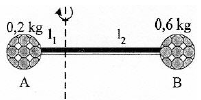
Massa of A (mA) = 0.2 kg
Mass of B (mB) = 0.6 kg
Distance between A and the axis of rotation (rA) = 4 meter
Distance between B and the axis of rotation (rB) = 12 – 4 = 8 meters
Dikarepake: The moment of inertia of the system
Solusi:
The moment of inertia of A
IA = (mA)(rA2) = (0.2)(4)2 = (0.2)(16) = 3.2 kg m²2
The moment of inertia of B
IB = (mB)(rB2) = (0.6)(8)2 = (0.6)(64) = 38.4 kg m²2
The moment of inertia of the system :
aku = akuA + AkuB = 3.2 + 38.4 = 41.6 kg m2
5. A 6-N force is applied to a cord wrapped around a pulley of mass M = 5 kg and radius R = 20 cm. What is the angular acceleration of the pulley. The pulley is a uniform solid cylinder.
Dikenal:
Gaya (F) = 6 Newton
Mass (M) = 5 kg
Radius (R) = 20 cm = 20/100 m = 0.2 m
Dikarepake: Akselerasi sudut (α)
Solusi:
The moment of the force :
τ = F R = (6 Newton)(0.2 meters) = 1.2 N m
The moment of inertia for solid cylinder :
Aku = 1/2 MR2
I = 1/2 (5 kg)(0.2 m)2
I = 1/2 (5 kg)(0.04 m2)
I = 1/2 (0.2)
Aku = 0.1 kg/m2.
The angular acceleration :
τ = I α
α = τ / I = 1.2 / 0.1 = 12 rad s-2
6. A block of mass = 4 kg hanging from a cord wrapped around a pulley of mass = 8 kg and radius R = 10 cm. Acceleration due to gravity is 10 ms-2 . What is the linear acceleration of the block? The pulley is a uniform solid cylinder.
Dikenal:
Mass of pulley (m) = 8 kg
Radius of pulley (r) = 10 cm = 0.1 m
Massa balok (m) = 4 kg
Akselerasi amarga gravitasi (g) = 10 m/s2
Bobot (w) = mg = (4 kg)(10 m/s)2) = 40 kg m/s2 = 40 Newton
Dikarepake: The free fall acceleration of the block
Solusi:
The moment of inertia of the solid cylinder :
Aku = 1/2 MR2 = 1/2 (8 kg)(0.1 m)2 = (4 kg)(0.01 m2) = 0.04 kg m2
The moment of the force :
τ = F r = (40 N)(0.1 m) = 4 Nm
The angular acceleration :
Στ = Iα
4 = 0.04 α
α = 4 / 0.04 = 100
The linear acceleration :
a = r α = (0.1)(100) = 10 m/s2
7. A block with mass of m hanging from a cord wrapped around a pulley. If the tiba gratis acceleration of the block is a m/s2, what is the moment of inertia of the pulley..
Dikenal:
weight = w = m g
Lever arm = R
The angular acceleration = α
The free fall acceleration of the block = a ms-2
Dikarepake: The moment of inertia of the pulley (I)
Solusi:
The connection between the linear acceleration and the angular acceleration :
a = R α
α = a / R
The moment of inertia :
τ = I α
I = τ : α = τ : a / R = τ (R / a) = τ R a-1
The angular momentum
8. A 0.2-gram particle moves in a circle at a constant speed of 10 m/s. The radius of the circle is 3 cm. What is the angular momentum of the particle?
Dikenal:
Mass of particle (m) = 0.2 gram = 2 x 10⁻⁴ kg
Angular speed (ω) = 10 rad s-1
Radius (r) = 3 cm = 3 x 10⁻² meter
Dikarepake: The angular momentum of the particle
Solusi:
The equation of the angular momentum :
L = Iω
I = the angular momentum, I = the moment of inertia, ω = the angular speed
The moment of inertia (for particle) :
Aku = Pak2 = (2 x 10⁻⁴ )(3 x 10⁻²)2 = (2 x 10⁻⁴ )(9 x 10⁻⁴) = 18 x 10-8
Momentum sudut:
L = I ω = (18 x 10-8)(10 rad s-1) = 18 x 10-7 kg m2 s-1
- What is rotational motion?
- jawaban: Rotational motion refers to the movement of an object around a fixed axis. It’s the kind of motion in which every point of the object moves in a circle about the axis.
- How does linear velocity relate to angular velocity in rotational motion?
- jawaban: Linear velocity () of a point in a rotating object is directly proportional to its distance () from the axis of rotation and the angular velocity () of the object. The relation is given by .
- What is the moment of inertia, and how does it relate to rotational motion?
- jawaban: Moment of inertia is the rotational analog of mass in linear motion. It measures an object’s resistance to changes in its rotational state. The moment of inertia depends on both the mass of an object and its distribution relative to the axis of rotation.
- How does Newton’s first law of motion apply to rotational motion?
- jawaban: Just as an object in linear motion remains in motion unless acted upon by an external force, an object in rotational motion will remain in that state unless acted upon by an external torque.
- What is the significance of the radius of gyration?
- jawaban: The radius of gyration provides a measure of the distribution of an object’s mass away from its axis of rotation. It essentially describes how far from the axis all of the object’s mass would need to be concentrated to have the same moment of inertia as the original distribution.
- What is angular momentum and how is it conserved?
- jawaban: Angular momentum is the rotational equivalent of linear momentum. It is the product of an object’s moment of inertia and its angular velocity. In a closed system, the total angular momentum remains constant unless acted upon by an external torque, highlighting the conservation of angular momentum.
- How does torque influence rotational motion?
- jawaban: Torque is the rotational equivalent of force. It causes changes in the rotational motion of an object. The relation is given by Newton’s second law for rotation: , ngendi is the torque, yaiku momen inersia, lan is the angular acceleration.
- How does the center of mass differ from the center of rotation?
- jawaban: While they can coincide, the center of mass is the point where the entire mass of an object can be assumed to be concentrated for the purpose of calculations in linear motion, whereas the center of rotation is the point (or axis) about which an object rotates.
- What is the role of the centripetal force in rotational motion?
- jawaban: Centripetal force is the net force acting on an object moving in a circular path, directed towards the center of rotation. It’s responsible for keeping an object in its curved path and preventing it from moving in a straight line due to inertia.
-
How is rotational kinetic energy related to the moment of inertia and angular velocity?
- jawaban: Rotational kinetic energy is the energy due to the rotation of an object about an axis. It is given by the formula: , ngendi is the moment of inertia and yaiku kecepatan sudut.

