Diffusion

Ef við lítum vel sést fyrst reykurinn frá brunanum. Eftir smá stund sést hann ekki lengur. Hefurðu notað ilmvatn? Jafnvel þótt þú úðir ilmvatni í herberginu geta aðrir sem eru utan heimilisins líka fundið ilminn af ilmvatninu. Ef móðirin eldar ljúffengan og girnilegan mat í eldhúsinu má einnig finna ilminn af matreiðslunni frá húsi nágrannans. Af hverju er það?

Það eru mörg önnur dæmi. Ef þú setur nokkra dropa af bleki í glas sem inniheldur tært vatn, mun blek eða matarlitur dreifast jafnt um vatnið. Þetta gerist sjálfkrafa. Nokkur fyrri dæmi eru dreifingaratburðir sem oft eiga sér stað í daglegu lífi. Dreifing er ferlið við að færa efni úr háum styrk í lágan styrk. Það sem átt er við með styrk er fjöldi sameinda/móls af efni á rúmmáli. Staður með háum styrk er staður þar sem eru margar sameindir af efnum á rúmmáli. Aftur á móti eru lágir styrkir staðir þar sem eru fáar sameindir á rúmmáli.
Lesa meira

Innri orka hugsjónargass

Orka í einstofna hugsjóngasi

Orkan í einstofna hugsjóngasinu er heildarmagn þýðingarhreyfiorku einstofna hugsjóngassameindanna. Heildarmagn þýðingarhreyfiorku hugsjóngassameindanna = margfeldi meðalþýðingarhreyfiorku hverrar sameindar og fjölda sameinda (N). Stærðfræðilega:

Lesa meira

Setning um jafnskiptingu orku

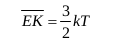
The energy equipartition theorem was derived theoretically by Clerk Maxwell using statistical mechanics. It is called a theorem because there is no proof through experimentation. The energy partition means equal distribution of energy.

Energy equipartition theory 1

KE = average translational kinetic energy of gas molecules (Joule)

k = Boltzmann’s constant = 1.38 x 10⁻²³ J/K

T = absolute temperature of the ideal gas molecule (Kelvin)

Lesa meira

Meðalhreyfiorka lofttegunda

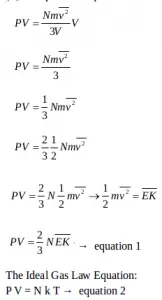
Auk þrýstings er hitastig (T) ein af stærðunum sem lýsir makróskópískum eðli gass. Jafna fyrir gasþrýsting:

Meðalhreyfiorka lofttegunda 1

Lesa meira

Hreyfifræðikenning um lofttegundir

K-iðinetic theory states that every substance consists of atoms or molecules and that the atom or molecule moves continuously carelessly. This assumption of kinetic theory matches the situation and condition of the atom or molecule of the gas constituent. The force of attraction between the atoms or molecules making up the gas is feeble so that atoms or molecules can move freely.

Lesa meira

Lög Boyles, lög Charless, lög Gay-Lussacs

Article Boyle’s law, Charles’s law, Gay-Lussac’s law

Lögmál Boyle

Robert Boyle (1627-1691) conducted experiments to investigate the quantitative relationship between gas pressure and volume. This experiment is carried out by inserting a certain amount of gas into a closed container. Until a pretty good approach, he found that if the gas temperature was kept constant, then when the gas pressure increased, the gas volume was reduced. Likewise, when the gas pressure decreases, the gas volume increases. Gas pressure is inversely proportional to gas volume. This relationship is known as Boyle’s Law. Mathematically:

Lesa meira

Lögmálið um hugsjón gas

Gaslögmál Boyle, Charles-lögmálsins og Gay-Lussac-lögmálsins eiga ekki við um allar gasaðstæður, þannig að greining okkar verður erfiðari. Þess vegna kynnum við líkanið fyrir kjörgas. Kjörgas er ekki til í daglegu lífi; kjörgas er hin fullkomna mynd til að auðvelda greiningu. Tilvist þessa hugtaks um kjörgas hjálpar okkur einnig mjög að skoða tengslin milli þriggja gaslögmálanna.

Sambandið milli hitastigs, rúmmáls og gasþrýstings

Með því að vísa til þriggja gaslögmálanna hér að ofan getum við leitt út almennara samband milli hitastigs, rúmmáls og gasþrýstings.

Lesa meira

Óreiða

The specific statements of the second law of thermodynamics can’t describe for all irreversible processes, so we need a general statement. This general statement is expected to explain all irreversible processes occurring in the universe. The general statement of the second law of thermodynamics was formulated in the mid-nineteenth century, through a quantity called entropy (S). Entropy was first introduced by Clausius and was formulated from the Carnot cycle (perfect caloric engine). According to Clausius, entropy changes are experienced by a system, when the system gets additional heat (Q) at a constant temperature, which is represented by the equation:

Lesa meira

Afkastastuðull kælivélarinnar

Article about Coefficient of performance of the cooling machine

A cooling machine is a machine that takes heat from a low-temperature place, then transfers it to a high-temperature area. For this process to happen, the machine must do the work because the heat naturally flows from high temperature to low temperature. This is by Clausius’s statement:

It is impossible for a cooling machine to transfer heat from a low-temperature place to a high-temperature place, without work (Second law of thermodynamics—Clausius statement).

The machine works (W) to transfer heat, from low temperature (QL) to high temperature (QH). Based on conservation of energy, QL + W = QH.

Lesa meira

Carnot-hitavél og Carnot-hringrás

To find out how to increase the efficiency of hitinn engine, a French scientist named Sadi Carnot (1796-1832) examined an ideal theoretical caloric machine in 1824. At that time, the first law of thermodynamics had not been formulated, nor the second law of thermodynamics. The first law has not been formulated because scientists do not yet know that heat is energy. After Joule and his colleagues experimented in the 1830s, scientists discovered heat is energy that moves due to temperature differences. So, the first law of thermodynamics was formulated after 1830. Sadi Carnot had been researching the theoretical ideal caloric engine in 1824. His research was actually to increase the efficiency of the steam engine. Most steam engines of that time were less efficient.

Lesa meira