Az elektromágneses hullámok fogalma

Concept of Electromagnetic Waves: A Journey Through Space and Time Electromagnetic waves have been fundamental to our understanding of the universe and our everyday technological advancements. From ancient speculative theories to the sophisticated scientific paradigm of today, the concept of electromagnetic waves has undergone substantial evolution. This article delves into the genesis, properties, applications, and … Részletek

A tömeg és a súly közötti kapcsolat

# The Relationship Between Mass and Weight: An Intricate Dance in Physics Understanding the concepts of mass and weight lies at the heart of physics and our interpretation of the physical world. Despite their frequent interchangeability in everyday language, mass and weight are distinct entities with unique characteristics. This article delves into the intricacies of … Részletek

Hogyan számítsuk ki a potenciális energiát

How to Calculate Potential Energy Potential energy (PE) is one of the fundamental concepts in physics. It describes the energy possessed by an object due to its position, composition, or condition. There are various forms of potential energy including gravitational potential energy, elastic potential energy, and chemical potential energy. Understanding how to calculate potential energy … Részletek

A skalárok és a vektorok közötti különbség a fizikában

Difference Between Scalar and Vector in Physics In the realm of physics, understanding the fundamental concepts of scalar and vector quantities is crucial to the accurate analysis and description of physical phenomena. These two types of quantities form the bedrock upon which various principles and laws of physics are built. This article delves into the … Részletek

Einstein relativitáselméletének magyarázata

Explanation of Einstein’s Theory of Relativity Albert Einstein’s theories of relativity, comprising the Special Theory of Relativity (1905) and General Theory of Relativity (1915), revolutionized our understanding of space, time, and gravity. These theories are pillars of modern physics, influencing various fields from cosmology to quantum mechanics. In this article, we explore these theories’ fundamentals, … Részletek

Példák az egyenletes lineáris mozgás problémáira

# Examples of Uniform Linear Motion Problems Uniform linear motion, also known as uniform rectilinear motion, refers to the movement of an object at a constant speed along a straight path. This type of motion is characterized by a constant velocity, implying there is no acceleration. In various fields such as physics, engineering, and everyday … Részletek

Newton első törvényének megértése

Understanding Newton’s First Law Sir Isaac Newton’s contributions to science were groundbreaking, and his First Law of Motion, often referred to as the Law of Inertia, stands as one of the most fundamental principles in physics. This law establishes the foundation for classical mechanics and helps us understand the behavior of objects in motion or … Részletek

Gravitációs egyenlet

3 kérdés a gravitációs egyenletről

1. Három, egyenként 1 kg tömegű részecske helyezkedik el egy egyenlő oldalú háromszög csúcsaiban, amelynek oldalai 1 m hosszúak. Mekkora a gravitációs erő (G-ben) az egyes pontszerű részecskékre hat?

MegoldásGravitációs egyenlet 1
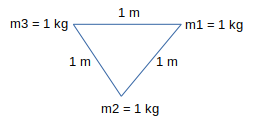
Az egyik részecske által tapasztalt gravitációs erő nagysága.

F12 = G (m1)(m2)/r2 = G(1)(1) / 12 = G/1 = G

F13 = G (m1)(m3)/r2 = G(1)(1) / 12 = G/1 = G

Az 1. pontban keletkező gravitációs erő:

Részletek

Elektromos tér egyenlet

3 kérdés az elektromos tér egyenletekről

1. Egy 10 cm sugarú vezető gömb 500 μC elektromos töltésű. Az A, B és C pontok a gömb középpontjával egy vonalban fekszenek, attól rendre 12 cm, 10 cm és 8 cm távolságra. Számítsa ki az elektromos térerősséget az A, B és C pontokban!

Ismert:Elektromos tér egyenlet 1

A vezető gömb sugara (R) = 10 cm = 0.1 m

Elektromos töltés (q) = 500 μC = 500 x 10-6 C

rA = 12 cm = 0,12 m

rB = 10 cm = 0,1 m

rC = 8 cm = 0,08 m

Coulomb-állandó (k) = 9 x 10⁹

Wanted: Az elektromos térerősség az A pontban (EA), a B pontban (EB) és a C pontban (EC)

Megoldás:

Részletek

Rugóállandó egyenlet

3 kérdés a rugóállandó egyenletéről

1. Egy szabadon felfüggesztett rugó hossza 10 cm. A szabad végén egy 200 grammos súly van felfüggesztve úgy, hogy a rugó hossza 11 cm legyen. Ha g = 10 m/s2, mi a rugóerő állandója?

Ismert:

A rugó kezdeti hossza (y1) = 10 cm = 0.10 m

A rugó végső hossza (y2) = 11 cm = 0.11 m

Rugóhossz-változás (Δy) = 0.11 – 0.10 = 0.01 méter

A rakomány tömege (m) = 200 gramm = 0.2 kg

Teherbírás (w) = mg = (0,2)(10) = 2 Newton

Wanted: Rugóállandó (k)

Megoldás:

Részletek