Lub capacitor phaj sib luag

Definition of the parallel plate capacitor

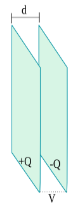
Parallel plate capacitor 1The parallel plate capacitor is a capacitor that consists of two parallel conductor plates, each plate having an equal cross-sectional area (A) and two plates separated by a certain distance (d), as shown in the figure left. One of the conductor plates is positively charged (+Q) while the other conductor plate is negatively charged (-Q), where the amount of hluav taws xob on each plate is equal. So that the charge does not move to the air molecule, the capacitor is isolated from the environment, and between the two plates, there is a vacuum.

nyeem ntxiv

Kepler txoj cai lij choj

Article about Kepler txoj cai lij choj

Do you still remember the memories of first riding a car? When in a moving car, you see as if a tree or building is moving. At that time, you might think the trees or buildings are moving, while you and the car are in rest. In fact, you and the car move, while the trees or buildings are rest. This experience of fake motion is actually experienced every day. Every morning, “sunrises” on the eastern horizon then move west and “sets” on the western horizon in the afternoon.

Likewise, at night, you often see the moon moving from east to west. Have you ever thought or guessed that the sun and moon moved around the earth, while the earth was in rest?

nyeem ntxiv

Lub sijhawm ntawm lub zog

Article about Moment of force

1. Lever arm

Review an object that rotates, such as the door of a room. When the door is opened or closed, the door rotates. The hinges that connect the door to the wall act as the axis of rotation.

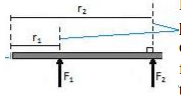
Moment of force 1The door image is seen from above. Review an example where the door is pushed in the same two forces that have the same magnitude and direction, where the direction of the force is perpendicular to the door. At first, the door is pushed with a force of F1, r1 from the axis of rotation. Subsequently, the door is pushed with the force of F2, r2 away from the axis of rotation. Although the magnitude and direction of the force F1 =F2, the force of F2 causes the door to rotate faster than the force of F1. In other words, the force of F2 causes a greater angular acceleration compared to the force of F1. You can prove this.

nyeem ntxiv

Txoj cai thib ob ntawm Newton txog kev txav mus los

Tsab xov xwm hais txog Newton txoj cai thib ob ntawm kev txav mus los

4.1 Kev sib raug zoo ntawm lub zog, lub zog inertia, thiab lub zog nrawm ntawm lub kaum sab xis

Yog tias muaj lub zog tshwm sim (ΣF) ua rau ib yam khoom nrog qhov hnyav (m) ces yam khoom txav mus los ncaj nraim nrog qee qhov kev nrawm (a). Kev sib raug zoo ntawm lub zog tshwm sim, qhov hnyav, thiab acceleration yog qhia los ntawm qhov sib npaug:

ΣF = ma

Qhov no yog qhov sib npaug ntawm Newtontxoj cai thib ob.

Cov nqi ntawm kev txav mus los uas zoo ib yam li lub zog tshwm sim (ΣF) hauv kev txav mus los ncaj yog lub zog tshwm sim (Στ). Cov nqi ntawm kev txav mus los uas zoo ib yam li qhov hnyav (m) hauv kev txav mus los ncaj yog lub sijhawm ntawm inertia (I). Cov nqi ntawm kev txav mus los uas zoo ib yam li kev nrawm (a) hauv kev txav mus los ncaj yog kev nrawm ntawm lub kaum sab xis (α).

nyeem ntxiv

Qhov chaw ntawm lub ntiajteb txawj nqus

1. Lub ntsiab lus ntawm nruab nrab ntawm lub ntiajteb txawj nqus

Ib lub cev khov kho muaj ntau yam khoom me me; yog li ntawd, lub zog gravitational ua rau txhua yam khoom me me no. Hauv lwm lo lus, txhua yam khoom me me muaj nws qhov hnyav. Qhov chaw nruab nrab ntawm lub ntiajteb txawj nqus ntawm ib yam khoom yog ib qho chaw ntawm yam khoom uas qhov hnyav ntawm txhua qhov ntawm yam khoom raug suav hais tias yog qhov chaw nruab nrab ntawm qhov ntawd.

nyeem ntxiv

Hom kev sib npaug ntawm lub cev khov kho

Article about the Types of equilibrium of the rigid body

Not all things we find in everyday life always rest. Maybe at first the object rest, but if it is moved (for example by the wind) objects can move. The problem is, whether after moving, objects return to their original position or not. This depends on the type of balance of the object. After moving, there will be three possibilities, namely:

(1) the object returns to its original position,

(2) the object moves away from its original position,

(3) the object remains in its new position.

nyeem ntxiv

Kev sib npaug ntawm lub cev khov kho

Tsab xov xwm hais txog Kev Sib Npaug ntawm Lub Cev Rigid

1. Thawj qhov xwm txheej

Txoj Cai Thib Ob ntawm Newton hais tias yog tias lub zog tshwm sim rau ib yam khoom (ib yam khoom uas suav tias yog ib qho khoom me me) tsis yog xoom,

ces yam khoom yuav txav mus nrog qhov nrawm tas li, qhov twg qhov kev taw qhia ntawm yam khoom txav mus los = qhov kev taw qhia ntawm tag nrho lub zog. Yog tias lub zog tshwm sim yog xoom, ces yam khoom ntawd nyob twj ywm lossis txav mus los ntawm qhov ceev tas li.

ΣF = ma

Thaum ib yam khoom nyob twj ywm lossis txav mus rau qhov ceev tas li, yam khoom ntawd tsis muaj kev nrawm (a). Vim tias kev nrawm (a) = 0, qhov sib npaug saum toj no hloov mus rau:

nyeem ntxiv

Cov caij nplooj ntoos hlav hauv series thiab parallel

Tsab xov xwm hais txog qhov Cov caij nplooj ntoos hlav hauv series thiab parallel

1. Cov caij nplooj ntoos hlav hauv series

Yog tias lub caij nplooj ntoos hlav txuas nrog ua ke, zoo li hauv daim duab ntawm sab, ces:

1. Qhov ntev ntawm lub caij nplooj ntoos hlav nce ntxiv = qhov ntev ntxiv 1 + qhov ntev ntxiv 2

Δy = Δy1 + Δy1

2. Lub zog uas lub caij nplooj ntoos hlav sib npaug ntsib = lub zog uas lub caij nplooj ntoos hlav 1 ntsib = lub zog uas lub caij nplooj ntoos hlav 2 ntsib

Fs =F1 =F2

nyeem ntxiv

Txoj cai ntawm Hooke

1. Txoj cai Hooke rau cov caij nplooj ntoos hlav

Yog tias lub caij nplooj ntoos hlav raug rub mus rau sab xis, lub caij nplooj ntoos hlav yuav ncab thiab ntev dua (daim duab 1). Yog tias lub zog rub tsis loj, nws pom tias qhov nce ntawm lub caij nplooj ntoos hlav ntev (Δx) yog proportional rau qhov loj ntawm lub zog rub (F). Hauv lwm lo lus, qhov loj dua lub zog rub, qhov ntev ntawm lub caij nplooj ntoos hlav loj dua. Kev sib piv ntawm qhov loj ntawm lub zog rub (F) thiab qhov nce ntawm lub caij nplooj ntoos hlav ntev (Δx) yog tas li.

nyeem ntxiv

Ohm txoj cai

Kev txhais ntawm Ohm txoj cai

Yuav luag txhua tus hlau conductors, lub teb hluav taws xob yog proportional rau qhov ceev ntawm lub hluav taws xob tam sim no, qhov twg qhov piv ntawm lub teb hluav taws xob rau qhov ceev ntawm lub hluav taws xob tam sim no yog tas li. Mathematically qhia los ntawm equation:

ρ = E / J

E = fais fab teb, ρ = tawm tsam, J = tam sim no ceev

Tus nqi ρ tas li hu ua resistivity, uas nws tus nqi yog tas li thiab tsis nyob ntawm lub zog hluav taws xob uas ua rau muaj hluav taws xob tam sim no.

nyeem ntxiv