1. प्रारंभिक अवस्था में दो गैसों का दाब P और तापमान T है। गैस समआयतनिक अभिक्रिया से गुजरती है जिससे अंतिम दाब प्रारंभिक दाब का चार गुना हो जाता है। गैस का अंतिम तापमान क्या होगा?
ज्ञात :
प्रारंभिक दाब (पी 1 ) = पी
अंतिम दाब (P 2 ) = 4P
प्रारंभिक तापमान (T 1 ) = T
वांछित: अंतिम तापमान (T 2 )
समाधान:
गे-लुसैक के नियम का सूत्र :
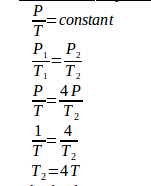
अंतिम तापमान प्रारंभिक तापमान का चार गुना हो जाता है।
[आईआरपी]
2. एक बंद पात्र में, आदर्श गैसों का प्रारंभिक तापमान 27 ° C है। यदि अंतिम दाब प्रारंभिक दाब का 2 गुना हो जाता है, तो अंतिम तापमान क्या होगा?
ज्ञात :
प्रारंभिक दाब (पी 1 ) = पी
अंतिम दाब (P 2 ) = 2P
प्रारंभिक तापमान (T 1 ) = 27 ° C + 273 = 300 K
वांछित: अंतिम तापमान (T 2 )
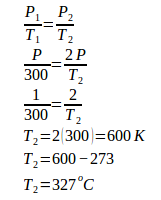
समाधान:
[आईआरपी]
3. एक टायर में 27°C तापमान पर 2 atm के गेज दबाव तक हवा भरी जाती है। गाड़ी चलाने के बाद, टायर के अंदर का तापमान बढ़कर 47°C हो जाता है। अब टायर के अंदर का दबाव कितना है?
ज्ञात :
वायुमंडलीय दाब = 1 atm = 1 x 10⁵ Pa
प्रारंभिक गेज दाब = 2 atm = 2 x 10⁵ Pa
प्रारंभिक निरपेक्ष दाब (P 1 ) = 1 atm + 2 atm = 3 atm = 3 x 10 5 Pa
प्रारंभिक तापमान (T 1 ) = 27 ° C + 273 = 300 K
अंतिम तापमान (T 1 ) = 47 ° C + 273 = 320 K
अंतिम गेज तापमान चाहिए
समाधान:
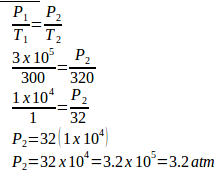
अंतिम गेज दबाव = अंतिम निरपेक्ष दबाव – वायुमंडलीय दबाव
अंतिम गेज दबाव = 3.2 atm – 1 atm
अंतिम गेज दबाव = 2.2 एटीएम
