Labari game da Daidaito na ruwan tabarau masu haɗuwa (convex)
Kafin ka koyi lissafin ruwan tabarau mai siffar convex, ka fahimci ƙa'idodin alamun ruwan tabarau mai siffar convex da ke ƙasa.
Dokokin alamun ruwan tabarau masu lanƙwasa
– Nisa tsakanin abu (yi)
Idan an wuce abu ta cikin hasken haske, to nisan abu yana da kyau.
– Nisa ta hoton (di)
Idan hasken ya wuce hoton, to nisan hoton yana da kyau (ainihin hoto). Idan hasken bai wuce ta hoton ba, nisan hoton yana da kyau (ainihin hoto).
– Tsawon mai da hankali (f)
Idan hasken ya ratsa ta cikin ruwan tabarau, tsawon hasken yana da kyau. Akasin haka, idan hasken bai ratsa wurin hasken ba, tsawon hasken yana da kyau. Matsakaicin hasken yana da kyau. Matsakaicin hasken yana ratsa ta cikin hasken. Saboda haka, tsawon hasken yana da kyau.
– Tsayin abu (ho)
Idan abu yana sama da babban axis, to tsayin abu an sanya masa alama mai kyau (abu yana tsaye). Akasin haka, idan abu yana ƙasa da babban axis na ruwan tabarau mai lanƙwasa, tsayin abu yana da korau (an juya abu).
– Tsawon hoton (hi)
Idan hoton yana sama da babban ginshiƙi, tsayin hoton yana da kyau (hoton yana tsaye). Idan hoton yana ƙasa da babban ginshiƙi, tsayin hoton yana da kyau (hoton yana juyawa).
- Girman hoto (m)
Idan girman hoto > 1, to girman hoton ya fi girman abu. Idan girman hoton = 1, to girman hoton yayi daidai da girman abu. Idan girman hoton < 1 ne, girman hoton ya fi girman abu.
Daidaito na ruwan tabarau mai siffar convex
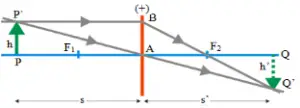
s = yi = nisan abu, s' = di = nisan hoto, ho = P P' = tsayin abu, hi = Q Q' = tsayin hoton, F 1 da F 2 = wurin da aka fi mayar da hankali na ruwan tabarau mai haɗuwa.
Alwatika na P'AP yayi kama da alwatika na Q'AQ. Saboda haka:
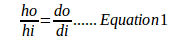
Alwatika BF 2 A = Q'F 2 Q inda nisan AB = tsayin abu (h) da nisan F2A = tsayin mai da hankali (f) na ruwan tabarau mai lanƙwasa. Saboda haka:
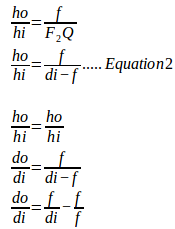

do = nisan abu (positive idan hasken ya wuce abin ta hanyar hasken)
di = nisan hoton (tabbatacce idan hoton ya wuce ta hanyar hasken ko hoton gaskiya ne)
f = tsawon mai da hankali (tabbatacce idan hasken ya wuce wurin mai da hankali na ruwan tabarau mai convex)
Koyaushe ku tuna da ƙa'idodin alamun ruwan tabarau masu siffar ƙwallo lokacin amfani da wannan lissafin don magance matsalar ruwan tabarau masu siffar ƙwallo.
Girman hoto (m)
Lura da samuwar hoton da ke sama. Kamar alwatika na PAP 'da QAQ', za mu iya gano alaƙar da ke tsakanin nisan abu da nisan hoton tare da tsayin abu da tsayin hoton:

Za a iya sake rubuta lissafin da ke sama kamar haka a ƙasa ta hanyar ƙara alamar m:
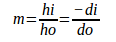
m = girman hoton
ho = tsayin abu (tabbatacce idan abu yana sama da babban ginshiƙin ruwan tabarau mai lanƙwasa ko kuma abu yana tsaye)
hi = tsayin hoton (mara kyau idan hoton yana ƙasa da babban ginshiƙin ruwan tabarau mai lanƙwasa ko kuma an juya hoton)
do = nisan abu (positive idan hasken ya wuce abin ta hanyar hasken)
di = nisan hoton (tabbatacce idan hoton ya wuce ta cikin hasken ko kuma hoton gaskiya ne)
