Gluasad loidhneach neo-aonfhoirmeil - duilgheadasan agus fuasglaidhean
1.
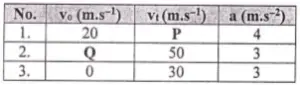
Tha an clàr gu h-àrd a’ sealltainn dàta trì nithean a bhios a’ siubhal an aon astar aig luathachadh cunbhalach.
Dè an astar deireannach aig nì P agus an astar tùsail aig nì Q?
fuasgladh:
An toiseach, obraich a-mach an astar a shiubhail nì 3.
Astar a shiubhail nì 3 :
Aithnichte :
Astar tùsail (v o ) = 0 m/s
Astar deireannach (vt ) = 30 m/s
Luathachadh (a) = 3 m/ s²
A dhìth : Astar
fuasgladh:
vt 2 = v o 2 + 2 mar a tha
vt 2 – v o 2 = 2 mar a tha
30 2 – 0 2 = 2 (3) diogan
900 – 0 = 6 diogan
900 = 6 diogan
s = 900 / 6
s = 150 meatair
An astar deireannach aig nì 1 :
Aithnichte:
Astar tùsail (v o ) = 20 m/s
Luathachadh (a) = 4 m/ s²
Astar (diogan) = 150 meatair
A dhìth: Astar deireannach (v t )
fuasgladh:
vt 2 = v o 2 + 2 mar a tha
vt 2 = 20 2 + 2 (4) ( 150)
vt2 = 400 + 1200
vt2 = 1600
v t = 40 m/s
Astar tùsail nì 2:
Aithnichte:
Astar deireannach (vt ) = 50 m/s
Luathachadh (a) = 3 m/ s²
Astar (diogan) = 150 meatair
A dhìth: Astar tòiseachaidh (v o )
fuasgladh:
vt 2 = v o 2 + 2 mar a tha
vt² – 2 mar a tha = v²
50 2 – 2(3)(150) = v o 2
2500 – 900 = bho 2
1600 = v o 2
v o = 40 m/s
2. Bidh trì nithean a’ siubhal air plèana còmhnard aig luathachadh cunbhalach. Tha an aon luathachadh aig na trì nithean. Dàta nan trì nithean nuair a bhios iad a’ siubhal ann an 10 diogan, air a shealltainn san fhigear gu h-ìosal.

Obraich a-mach P agus Q.
fuasgladh:
An toiseach, obraich a-mach luathachadh nì 1.
Luathachadh nì 1:
Aithnichte:
An astar tùsail (v o ) = 2 m/s
An astar deireannach (v t ) = 22 m/s
Astar (diogan) = 120 meatair
A dhìth: Astar
fuasgladh:
vt 2 = v o 2 + 2 mar a tha
vt 2 – v o 2 = 2 mar a tha
22 2 – 2 2 = 2 a (120)
484 – 4 = 240
480 = 240 a
a = 480/240
a = 2 m/ s²
Astar tùsail nì 2 :
Aithnichte:
Luathachadh (a) = 2 m/ s²
Astar deireannach (vt ) = 24 m/s
Astar (diogan) = 140 meatair
A dhìth: Astar tòiseachaidh (v o )
fuasgladh:
vt 2 = v o 2 + 2 mar a tha
24 2 = v o 2 + 2 (2)(140)
576 = v o 2 + 560
576 – 560 = bho 2
16 = v o 2
v o = 4 m/s
Astar nì 3:
Aithnichte:
Astar tùsail (v o ) = 0 m/s
Astar deireannach (vt ) = 20 m/s
Luathachadh (a) = 2 m/ s²
A dhìth : Astar (ean)
fuasgladh:
vt 2 = v o 2 + 2 mar a tha
20 2 = 0 2 + 2 (2) diogan
20 2 = 2 (2) diogan
400 = 4 diogan
s = 400/4
s = 100 meatair s
3. Obraich a-mach an astar a shiubhail an nì ann an 40 diogan.
fuasgladh: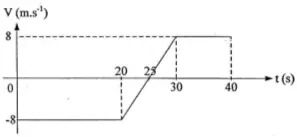
Farsaingeachd 1 = farsaingeachd ceart-cheàrnach = (20-0)(8-0) = (20)(8) = 160 meatair
Farsaingeachd 2 = farsaingeachd triantan = ½ (25-20)(8-0) = ½ (5)(8) = (5)(4) = 20 meatair
Farsaingeachd 3 = farsaingeachd triantan = ½ (30-25)(8-0) = ½ (5)(8) = (5)(4) = 20 meatair
Farsaingeachd 4 = farsaingeachd ceart-cheàrnach = (40-30)(8-0) = (10)(8) = 80 meatair
An astar a shiubhail ann an 40 diogan = 160 + 20 + 20 + 80 = 280 meatair
4. An t-atharrachadh ann an astar nì ann an 2 dhiog air a shealltainn leis a’ ghraf gu h-ìosal. Obraich a-mach an t-astar a shiubhail an nì.
fuasgladh: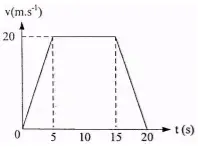
Farsaingeachd 1 = farsaingeachd triantan = ½ (5-0)(20-0) = ½ (5)(20) = (5)(10) = 50 meatair
Farsaingeachd 2 = farsaingeachd ceart-cheàrnach = (15-5)(20-0) = (10)(20) = 200 meatair
Farsaingeachd 3 = farsaingeachd triantan = ½ (20-15)(20-0) = ½ (5)(20) = (5)(10) = 50 meatair
Astar a chaidh a shiubhal rè 20 diogan = 50 + 200 + 50 = 300 meatair
- Dè an diofar a tha eadar gluasad loidhneach neo-aonfhoirmeil agus gluasad loidhneach aonfhoirmeil?
- freagair: Tha gluasad loidhneach neo-aonfhoirmeil a’ toirt a-steach atharrachadh ann an astar thar ùine, a’ ciallachadh gu bheil luathachadh an sàs. An coimeas ri sin, tha gluasad loidhneach aonfhoirmeil a’ ciallachadh gu bheil nì a’ gluasad le astar seasmhach agus gun luathachadh sam bith.
- Ciamar a tha an t-astar a shiubhail nì ann an gluasad loidhneach neo-aonfhoirmeil co-cheangailte ris an raon fon ghraf astair-ùine aige?
- freagair: Tha an astar a shiubhail nì ann an gluasad loidhneach neo-aonfhoirmeil co-ionann ris an raon fon ghraf astair-ùine aige.
- Ma tha graf luathachaidh-ùine nì na loidhne dhìreach chòmhnard os cionn ais na h-ùine, dè tha e a’ sealltainn mu ghluasad an nì?
- freagair: Tha e a’ comharrachadh gu bheil an nì a’ faighinn luathachadh adhartach cunbhalach. Tha astar an nì ag àrdachadh gu cunbhalach aig ìre sheasmhach.
- Carson nach gabh astar cuibheasach obrachadh a-mach gu sìmplidh mar chuibheasachd nan astaran tùsail is deireannach ann an gluasad neo-aonfhoirmeil?
- freagair: Airson gluasad neo-aonfhoirmeil, chan eil an astar seasmhach, agus mar sin dh’ fhaodadh an gluasad fhèin a bhith nas motha no nas lugha na tha air a ro-innse le bhith dìreach a’ faighinn cuibheasachd nan astaran tùsail is deireannach. Is e an dòigh cheart airson gluasad neo-aonfhoirmeil an astar a thoirt còmhla thairis air an eadar-ama ùine sònraichte no co-aontaran cinematic a chleachdadh a bheir cunntas air luathachadh.
- Ciamar a mhìnicheadh tu gluasad nì aig a bheil graf astair-ùine na loidhne dhìreach a tha a’ dol sìos?
- freagair: Tha loidhne dhìreach a’ dol sìos air graf astair-ùine a’ comharrachadh gu bheil an nì a’ gluasad le luathachadh àicheil cunbhalach, i.e., gu bheil e a’ slaodadh sìos no a’ slaodadh sìos ma bha astar dearbhach aige an toiseach.
- Ann an gluasad neo-aonfhoirmeil, ciamar a tha an astar sa bhad aig àm sònraichte co-cheangailte ri leathad graf gluasaid-ùine aig an àm sin?
- freagair: Tha an astar sa bhad aig àm sònraichte ann an gluasad neo-aonfhoirmeil air a thoirt seachad leis an leathad no an caisead a’ ghraf gluasaid-ùine aig a’ phuing shònraichte sin.
- Dè tha lùb air graf gluasad-ùine a’ moladh mu nàdar gluasad nì?
- freagair: Tha lùb air graf gluasaid-ùine a’ comharrachadh gluasad neo-chothromach, a’ ciallachadh gu bheil astar an nì ag atharrachadh (a’ dol am meud no a’ lùghdachadh) thar ùine.
- Ma tha graf gluasad-ùine nì parabolach agus a’ fosgladh suas, dè as urrainn dhut a thoirt a-mach mu a luathachadh?
- freagair: Ma tha graf an gluasaid-ùine na pharabola a dh’fhosglas suas, tha e a’ moladh gu bheil an nì a’ faighinn luathachadh deimhinneach cunbhalach.
- Ciamar a tha luathachadh nì ann an gluasad neo-aonfhoirmeil co-cheangailte ris an raon fon ghraf astar-ùine aige?
- freagair: Tha an t-atharrachadh ann an astar (a bheir an t-atharrachadh ann am momentum nuair a thèid iomadachadh leis a’ mhais) den nì ann an gluasad neo-aonfhoirmeil co-ionann ris an raon fon ghraf luathachaidh-ùine aige. Tha e cudromach a thoirt fa-near gu bheil a’ ghraf luathachaidh-ùine a’ toirt seachad an t-atharrachadh ann an astar, chan e an luathachadh gu dìreach.
- Dè a’ bhuaidh a th’ aig luathachadh àicheil (lughdachadh-luasg) air astar nì ann an gluasad neo-aonfhoirmeil?
- freagair: Bidh luathachadh àicheil, ris an canar gu tric lughdachadh, ag adhbhrachadh lùghdachadh ann an astar nì. Ma tha astar adhartach aig nì an toiseach agus ma thèid e tro luathachadh àicheil, lùghdaichidh an astar aige, agus ma leanas an lughdachadh, faodaidh an nì stiùireadh gluasaid atharrachadh.
