An dàrna lagh teirmeadainimic

Gus mìneachadh a dhèanamh air na pròiseasan teirmeadainimigeach neo-atharrachail, chruthaich na luchd-saidheans an dàrna lagh teirmeadainimigeach. Tha an dàrna lagh teirmeadainimigeach a’ mìneachadh dè na pròiseasan a dh’ fhaodas tachairt anns a’ chruinne-cè agus dè na pròiseasan nach urrainn tachairt. Rinn aon neach-saidheans leis an ainm RJE Clausius (1822-1888) an aithris a leanas:

Gu nàdarrach, bidh teas a’ gluasad bho nithean aig teòthachd àrd gu nithean aig teòthachd ìosal; gu nàdarrach, chan eil teas a’ dol bho nithean aig teòthachd ìosal gu nithean aig teòthachd àrd (An dàrna lagh de theirmidinimigs - aithris Clausius).

’S e aithris Clausius aon de na h-aithrisean sònraichte den dàrna lagh de theirmidinimig. Canar aithris shònraichte ris oir chan eil e a’ buntainn ach ri aon phròiseas a-mhàin, co-cheangailte ri gluasad teas. Leis nach eil an aithris seo co-cheangailte ri pròiseasan eile, feumaidh sinn aithris nas coitcheann. Tha leasachadh aithris choitcheann den dàrna lagh de theirmidinimig stèidhichte air sgrùdadh einnseanan teas. Mar sin, bruidhnidh sinn air teas einnsean an toiseach.
Leugh tuilleadh

Pròiseasan teirmeadainimigeach: Isothermal Adiabatic Isochoric Isobaric

Article Thermodynamic processes : Isothermal Adiabatic Isochoric Isobaric

There are four thermodynamic processes, namely Isothermal, isochoric, isobaric and adiabatic processes.

Isothermal Process (constant temperature)

In an isothermal process, system temperature is kept constant. Theoretically, the analyzed system is an ideal gas. Ideal gas temperature is directly proportional to ideal internal gas energy (U = 3/2 n R T). T does not change, so U also does not change. Thus, if applied to the isothermal process, the first law of the thermodynamic equation becomes:

Leugh tuilleadh

A’ chiad lagh de theirmeadainimic

Thermodynamic process

Heat (Q) is the energy that moves from one object to another because of the temperature difference. About systems and environments, heat is energy moving from system to environment or energy moving from environment to system, due to the temperature difference. If the system temperature is higher than the ambient temperature, heat will flow from the system to the environment. If the ambient temperature is higher than the system temperature, then heat flows from the environment to the system.

Heat (Q) is energy that moves due to the temperature difference, whereas work (W) is related to energy transfer through work. For example, if the system does work on the environment, then energy moves from system to environment. Conversely, if the environment does work on the system, then energy moves from environment to system.

Leugh tuilleadh

Bualaidhean Neo-elastaigeach

Bualaidhean Neo-elastaigeach

Chan eil lagh glèidhteachais lùth cineatach iomchaidh ann am bualaidhean neo-elastagach. Tha lagh glèidhteachais spionnadh iomchaidh ann am bualaidhean neo-elastagach mura h-eil feachd bhon taobh a-muigh ag obair air an dà nì a tha a’ bualadh. Ann am bualadh neo-elastagach, bidh dà nì a’ steigeadh ri chèile no ceangailte ri chèile às dèidh a’ bhualadh.

Eisimpleir ceist 1.

Tha an aon mhais aig dà nì, is e sin 1 kg. Bidh Nì 1 a’ gluasad air plèana rèidh aig astar 10 m/s agus a’ bualadh ri nì a dhà a tha na laighe. Às dèidh a’ bhualadh, bidh an dà nì a’ cumail ri chèile. Dè an astar a th’ aig an dà nì às dèidh a’ bhualadh?

Leugh tuilleadh

Bualaidhean pàirteach elastagach

Bualaidhean pàirteach elastagach

Ann am bualaidhean pàirt-leaghach, tha lagh glèidhteachais spionnadh iomchaidh, ach chan eil lagh glèidhteachais lùth cineatach iomchaidh. Aig an àm a thachras bualadh, thèid cuid de lùth cineatach a thionndadh gu lùth fuaim, lùth teas, agus lùth a-staigh. Tha cleachdadh an fhacail leaghach a’ sealltainn às dèidh a’ bhualaidh, nach eil an dà nì a’ cumail ri chèile ach a’ preabadh dheth.

Is e eisimpleir de bhualadh pàirt-leaghach bualadh aon-thaobhach dà mharmar no dà bhàla billiards.

Leugh tuilleadh

Glèidhteachas spionnadh loidhneach

Glèidhteachas spionnadh loidhneach

Tha lagh glèidhteachais momentum loidhneach ag ràdh mura h-eil feachd bhon taobh a-muigh ag obair air dà nì a tha a’ bualadh ri chèile, gu bheil momentum nan nithean ron bualadh co-ionann ri momentum nan nithean às dèidh a’ bhuille.

p1 +p2 = p1 ' + p2 ' ………………….. Co-aontar 1.4

m1 v1 +m2 v2 = m1 v1 ' + m2 v2 '

Ma bhios an dà nì a’ cumail ri chèile às dèidh dhaibh bualadh,

m1 v1 +m2 v2 = (m1 +m2 ) v'

Leugh tuilleadh

Bualaidhean gu foirfe elastagach

Bualaidhean gu foirfe elastagach

A collision of two objects is called a perfectly elastic collision if the momentum or kinetic energy of each object before the collision is equal to the momentum and kinetic energy of each object after the collision. In other words, the conservation of momentum law and conservation of kinetic energy law are applicable in perfectly elastic collisions. The use of the word elastic signifies that after the collision, the two objects do not stick together or are not attached to each other but bounce off. The momentum of each object is conserved.

The momentum of each object is conserved.

Leugh tuilleadh

Prionnsabal lùth-obrach meacanaigeach

Prionnsabal lùth-obrach meacanaigeach

The work-kinetic energy theorem states that the net work or the work done by the net force is equal to the change in kinetic energy.

Wlìon = KEt – GUo = 1⁄2 m(vt2 - vo2)

Wlìon = There are two types of forces, namely conservative force, and non-conservative force. Thus, net work can be considered to be comprised of the work done by a conservative force and the work done by a non-conservative force.

Wc + W.nc = ΔKE

Leugh tuilleadh

Obair air a dhèanamh le feachdan glèidhidh Lùth comasach

Obair air a dhèanamh le feachdan glèidhidh Lùth comasach

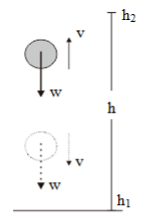
Observe an object which moves vertically upwards and then return to its initial position after reaching a maximum height. When the object is moving vertically upwards, weight does negative work on the object. When the object is moving upwards, the object’s height increases. Therefore, the object’s gravitational potential energy increases as well. It can be concluded that the negative work done by weight is equal to the increase in the object’s gravitational potential energy (PE).

Leugh tuilleadh

Feachd glèidhidh agus feachd neo-ghlèidhidh

Feachd glèidhidh agus feachd neo-ghlèidhidh

1. Conservative Force

1.1 Cuideam (w)

Conservative force and nonconservative force 1Observe an object which moves vertically upwards until reaching a maximum height before moving downwards towards its initial position. When moving vertically upwards by h, the weight is opposite in direction from displacement. Thus, the weight does negative work on the object. 

W = w h (cos 180o) = – wh = – mgh

After reaching a maximum height, the object moves downwards towards its initial position by h. When moving downwards, the weight is in the same direction as the displacement. Because it is in the same direction as displacement, the weight does positive work.

Leugh tuilleadh