Électricité statique – problèmes et solutions
Force électrique
1. Un point A est placé dans un champ électrique . L'intensité du champ électrique au point A est de 0.5 nC/ s . Si une charge de 0.25 C est placée au point A, quelle est la force électrique exercée sur cette charge ?
Connu :
Champ électrique au point A = 0.5 nC -1
Charge électrique au point A = 0.25 C
Recherche : Force électrique
Solution:
F = q E
F = (0.25 C)(0.5 NC -1 )
F = 0.125 N
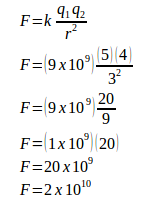
2. Deux charges de 5 C et 4 C sont séparées par une distance de 3 mètres. Si la constante de Coulomb est de 9 × 10⁹ N ·m² · C⁻² , quelle est l'intensité de la force électrique subie par ces deux charges ?
Connu :
Charge 1 (q 1 ) = 5 C
Charge 2 (q 2 ) = 4 C
Distance entre la charge 1 et la charge 2 (r) = 3 mètres
Constante de Coulomb ( k) = 9 × 10⁹ Nm² C⁻²
On cherche à déterminer l'intensité de la force électrique (F).
Solution:
3. Les charges électriques +q₁ = 10 μC, +q₂ = 20 μC et q₃ sont séparées, comme illustré dans la figure ci-dessous. La force électrique exercée sur la charge q₂ est nulle. Quelle est alors la charge de q₃ ?

Connu :
Charge 1 (q 1 ) = 10 μC = 10 x 10 -6 C
Charge 2 (q 2 ) = 20 μC = 20 x 10 -6 C
Recherche : Quelle est la charge de q3?
Solution:
Deux forces agissent sur +q 2.
La première force est la force répulsive entre la charge +q 1 et la charge +q 2 , qui est F 12 , vers la droite.
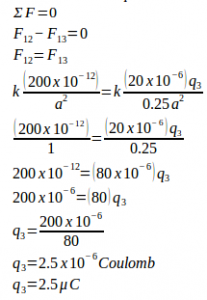
La force électrique nette agit sur q 2 = 0, alors q 3 doit être négatif.
La deuxième force est la force d'attraction entre la charge +q 2 et -q 3 , c'est-à-dire F 23 , vers la gauche.
Ces deux forces agissent sur q 2 , ont la même magnitude mais la direction opposée.
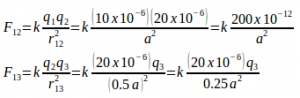
La force nette agit sur +q 2 = 0.
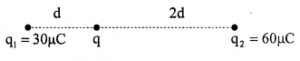
4. Trois charges q₁ , q₂ et q₃ sont alignées. Si q₁ = 5.0 μC et d = 30 cm, quelle est l'intensité et la direction de la force électrique qui s'exerce sur la charge q₂ ?
Connu :
Charge 1 (q 1 ) = 30 μC = 30 x 10 -6 C
Charge 2 (q 2 ) = 60 μC = 60 x 10 -6 C
Charge 3 (q) = 5 μC = 5 x 10⁻⁶ C
Distance entre q1 et q = d
Distance entre q 2 et q = 2d
d = 30 cm = 0.3 mètre
d² = (0.3) ² = 0.09
Constante de Coulomb ( k) = 9 x 10⁹ N m² C⁻²
On cherche à déterminer l'intensité et la direction de la force électrique agissant sur la charge électrique.
Solution:
Deux forces agissent sur q : F₁ vers la droite (q et q₁ sont positifs, donc F₁ s’éloigne de q et q₁ ) et F₂ vers la gauche (q et q₂ sont positifs, donc F₂ s’éloigne de q et q₂ ) . Calculez d’abord F₁ et F₂.
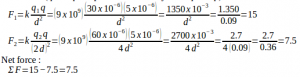 La force résultante est de 7.5 newtons. La direction de la force résultante est la même que celle de F.1, point vers la droite pour charger q2.
Champ électrique
5. Une charge ponctuelle q est placée au point P dans le champ électrique créé par la charge positive (+), de sorte qu'elle subit une force de 0.05 N dirigée vers cette charge. Si l' intensité du champ électrique au point P est de 2 × 10⁻² Nc , quelle est la valeur et la nature de la charge qui induit ce champ électrique ?
Connu :
Force électrique (F) = 0.05 N
Champ électrique (E) = 2 x 10 –2 NC –1 = 0.02 NC –1
Recherche : L'amplitude et le type de charge électrique
Solution:
La charge électrique est calculée à l'aide d'une formule qui exprime la relation entre la force électrique (F), le champ électrique (E) et la charge électrique (q) :
F = q E
q = F / E = 0.05 N / 0.02 nC –1 = 2.5 coulombs
La charge q subit une force électrique dans la direction de la charge (+) qui produit un champ électrique, donc la charge q est négative.
6. Les charges A et B sont séparées par une distance de 4 mètres. Le point C se situe entre les deux charges, à 1 mètre du point A. Si Q<sub> A</sub> = –300 μC et Q <sub> B </sub> = 600 μC, et que 1/4 π ε <sub>0</sub> = 9 × 10<sup> 9</sup> N m <sup> 2 </sup> C<sup>-2</sup>, quelle est l'intensité du champ électrique au point C produit par les deux charges ?
Connu :
Distance entre les charges A et B (r<sub> AB</sub> ) = 4 mètres
Distance entre le point C et la charge A (r AC ) = 1 mètre
Distance entre le point C et la charge B (r<sub> BC</sub> ) = 3 mètres
Charge A (q A ) = –300 μC = –300 x 10⁻⁶ C = –3 x 10⁻⁴ Coulomb
Charge B (q B ) = 600 μC = 600 x 10 -6 C = 6 x 10 -4 Coulombs
Constante ( k) = 9 × 10⁹ N m² C⁻²
Recherche : Champ électrique au point C
Solution:
Champ électrique produit par la charge A au point C :

La charge A est négative, de sorte que la direction du champ électrique pointe vers la charge A et s'éloigne de la charge B (vers la gauche).
Le champ électrique produit par la charge B au point C :

La charge B est positive, de sorte que la direction du champ électrique s'éloigne de la charge B et pointe vers la charge A (vers la gauche).
La résultante du champ électrique au point A :
E = E A + E B
E = (27 x 10⁵ ) + (6 x 10⁵ )
E = 33 x 10⁵ N /C
La direction du champ électrique pointe vers la charge A et s'éloigne de la charge B (vers la gauche).
7. Une particule de poussière de 1 mg flotte dans l'air. Si sa charge est de 0.5 μC et que l'accélération due à la gravité est de 10 m/s², déterminez l'intensité du champ électrique qui la maintient en suspension.
Connu :
Masse de poussière (m) = 1 mg = 1 x 10⁻⁶ kg
Charge de poussière (q) = 0.5 μC = 0.5 x 10⁻⁶ C
Accélération due à la gravité (g) = 10 m/ s²
Recherche : Champ électrique
Solution:
w = mg
w = poids de la poussière, m = masse de la poussière, g = accélération due à la gravité
La force de gravité agit sur la poussière :
w = mg = (1 x 10⁻⁶ kg )(10 m/s² ) = 10 x 10⁻⁶ kg m/s² = 10 x 10⁻⁶ Newtons
L'équation du champ électrique :
E = F/q
E = champ électrique, F = force électrique, q = charge électrique
Remplacez F dans l'équation du champ électrique par w dans l'équation du poids :
E = F/q = w/q
E = (10 x 10 -6 N) / (0.5 x 10 -6 C)
E = 10 N / 0,5 C
E = 20 N/C
8. Deux charges q₁ = 32 μC et q₂ = -214 μC sont séparées par une distance x, comme illustré ci-dessous. Le champ électrique est nul au point P situé à 10 cm de q₂ . Déterminez x.

Connu :
Charge 1 (Q 1 ) = 32 μC
Charge 2 (Q 2 ) = -214 μC
Distance du point P à q₁ = x + 10 cm
La distance du point P à q 2 = 10 cm
Recherché : x
Solution:
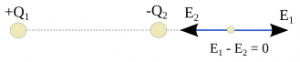
E₁ = champ électrique produit par la charge Q₁ . Ce champ est dirigé vers l'extérieur car Q₁ est positive. E₂ = champ électrique produit par Q₂ . Ce champ est dirigé vers Q₂ car Q₂ est négative.
Aucune force résultante n'est exercée au point p situé à 10 cm de Q2.
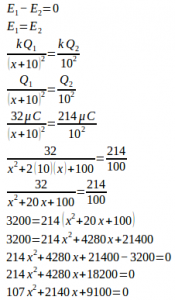
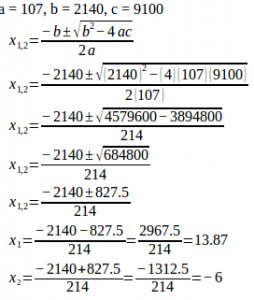
Utilisez la formule quadratique :
9. Un point chargé q se trouve au point P dans le champ électrique produit par la charge (+), et exerce donc une force de 0.05 N. Si la charge est de +5 × 10⁻⁶ Coulomb , quelle est l'intensité du champ électrique au point C ?
Connu :
Force électrique (F) = 0.05 Newtons
Charge électrique (Q) = +5 × 10⁻⁶ Coulomb = 0.000005
Recherche : Champ électrique au point P
Solution:
E = F / Q
E = 0.05 Newton / 0.000005 Coulomb
E = 5 Newton / 0.0005 Coulomb
E = 10 000 Newton/Coulomb
E = 10⁴ N /C
E = 10 4 NC -1
- Qu'est-ce que l'électricité statique ? Compagnie de SolutionL'électricité statique désigne l'accumulation de charges électriques à la surface des objets. Elle est qualifiée de « statique » car les charges restent localisées au lieu de se déplacer ou de circuler comme dans le cas du courant électrique.
- Comment l'électricité statique est-elle générée ? Compagnie de SolutionL'électricité statique est souvent générée par triboélectricité, un phénomène où certains matériaux se chargent électriquement au contact d'un autre matériau. Frotter un ballon contre ses cheveux ou marcher sur un tapis avec des chaussures à semelles de caoutchouc peut entraîner une accumulation de charges statiques.
- Pourquoi ressent-on parfois une décharge électrique en touchant une poignée de porte après avoir marché sur un tapis ? Compagnie de SolutionMarcher sur un tapis, surtout par temps sec, peut provoquer une accumulation de charges statiques sur le corps. Au contact d'une poignée de porte ou d'un autre conducteur, ces charges peuvent se décharger rapidement, entraînant une décharge électrostatique.
- Comment l'humidité affecte-t-elle l'électricité statique ? Compagnie de SolutionL'humidité tend à réduire l'accumulation d'électricité statique. Les molécules d'eau présentes dans l'air contribuent à dissiper les charges électriques. Par temps sec, le risque d'accumulation d'électricité statique et de décharges est plus élevé.
- Pourquoi certains matériaux sont-ils plus susceptibles de développer une charge statique que d'autres ? Compagnie de SolutionLes matériaux diffèrent par leur capacité à retenir ou à transférer des électrons. Certains matériaux, comme le caoutchouc ou certains plastiques, ont tendance à gagner ou à perdre des électrons plus facilement que d'autres, ce qui les rend plus sujets à l'accumulation de charges statiques.
- Quel est le principe de fonctionnement d'un électroscope ? Compagnie de SolutionUn électroscope est un appareil servant à détecter la présence de charges statiques. Il se compose généralement d'une tige métallique reliée à deux fines feuilles de papier métallique. Lorsqu'un objet chargé est approché de la tige, les feuilles s'écartent sous l'effet de la répulsion entre charges de même signe, indiquant ainsi la présence d'électricité statique.
- Comment la mise à la terre élimine-t-elle les charges statiques ? Compagnie de SolutionLa mise à la terre permet aux charges excédentaires de s'évacuer vers la Terre, vaste réservoir d'électricité statique. Lorsqu'un objet chargé statiquement est mis à la terre, les charges excédentaires sont neutralisées, réduisant ou éliminant ainsi l'accumulation d'électricité statique.
- Pourquoi peut-on observer des étincelles dans un silo à grains ou lors du ravitaillement d'un avion, et pourquoi est-ce dangereux ? Compagnie de SolutionLe mouvement ou le frottement des grains contre des surfaces peut générer de l'électricité statique, tout comme l'écoulement du carburant. L'accumulation de charges statiques peut se décharger sous forme d'étincelles. Dans les environnements contenant des gaz, des poussières ou des liquides inflammables (comme dans un silo à grains ou lors du ravitaillement d'un avion), ces étincelles peuvent enflammer le matériau inflammable et provoquer des explosions.
- Comment fonctionnent les sprays ou produits antistatiques ? Compagnie de SolutionLes sprays et produits antistatiques contiennent généralement des substances qui rendent les surfaces légèrement conductrices. Ce faisant, ils empêchent l'accumulation de charges statiques ou contribuent à dissiper celles qui s'accumulent déjà.
-
Qu'est-ce que la série triboélectrique ? Réponse : La série triboélectrique est un classement des matériaux selon leur tendance à se charger positivement ou négativement lorsqu'ils sont frottés contre un autre matériau. Les matériaux en haut de la liste ont tendance à se charger positivement, tandis que ceux en bas ont tendance à se charger négativement.
