Artikolo pri La leĝo de Kepler
Ĉu vi ankoraŭ memoras la memorojn pri via unua veturado per aŭto? Kiam vi estas en moviĝanta aŭto, vi vidas kvazaŭ arbo aŭ konstruaĵo moviĝas. Tiam vi eble pensas, ke la arboj aŭ konstruaĵoj moviĝas, dum vi kaj la aŭto ripozas. Fakte, vi kaj la aŭto moviĝas, dum la arboj aŭ konstruaĵoj ripozas. Ĉi tiu sperto de falsa moviĝo efektive spertas ĉiutage. Ĉiumatene, "sunleviĝoj" ĉe la orienta horizonto, poste moviĝas okcidenten kaj "subiras" ĉe la okcidenta horizonto posttagmeze.
Simile, nokte, vi ofte vidas la lunon moviĝi de oriento al okcidento. Ĉu vi iam pensis aŭ divenis, ke la suno kaj la luno moviĝis ĉirkaŭ la tero, dum la tero ripozis?
Historio de la evoluo de astronomio
Homoj, kiuj vivis en antikveco (komence a.K.), ankaŭ konsideris la sunon, lunon kaj aliajn ĉielajn korpojn moviĝantajn ĉirkaŭ la tero, dum la tero ripozas. Alivorte, la tero estas konsiderata la centro de la universo (geocentra). Ĉi tiu supozo baziĝas sur la limigita sensa sperto de homoj, kiuj ĉiutage observas la sunon, lunon kaj stelojn moviĝantajn, dum la tero sentas sin ripozanta. Simile al estado en moviĝanta aŭto, vi vidas kvazaŭ arboj aŭ konstruaĵoj moviĝas. La supozo, ke la tero estas la centro de la universo, estis esplorita kaj evoluigita de la greka astronomo Klaŭdio Ptolemaeo (100-170 p.K.) en la dua jarcento p.K. kaj kredis ĝin dum la sekvaj 1400 jaroj.
Laŭ Ptolemeo, la tero estis en la centro de la sunsistemo. La suno kaj la planedoj ĉirkaŭas cirklon (rotacia movo), kie la centro de ĉi tiu cirklo ĉirkaŭas la teron laŭ cirkla vojo (revolucia movo).
En 1543, la pola astronomo Nikolao Koperniko (1473-1543) proponis heliocentran modelon, laŭ kiu la suno troviĝas en la centro de la sunsistemo. La planedoj inkluzivas la teron ĉirkaŭ cirklo (rotacia movo), kie la centro de ĉi tiu cirklo ĉirkaŭas la sunon laŭ cirkla vojo (revolucia movo). Koperniko havis pli progresintan komprenon ol Ptolemeo, ĉar li lokigis la sunon en la centro de la sunsistemo. Tamen, Koperniko ankoraŭ uzas cirklojn kiel formon de planeda movo.
Ekscitaj debatoj pri geocentraj kaj heliocentraj modeloj instigas astronomojn fari pli zorgemajn observojn. Astronomoj tiutempe observis ĉielajn korpojn uzante nur la okulojn, ne uzis instrumentojn kiel teleskopojn aŭ stelbinoklon. Tiutempe, la teleskopo ankoraŭ ne estis fabrikita. La teleskopo, kiu povas esti uzata por observi ĉielajn korpojn, unue estis fabrikita de itala sciencisto, Galilejo, en 1609. Galilejo uzis sian artefaritan teleskopon por observi ĉielajn korpojn kaj uzis siajn observdatumojn por argumenti kun subtenantoj de la geocentra modelo.
Fama dana astronomo nomita Tycho Brahe (1546-1601) estis la lasta astronomo kiu observis ĉielajn korpojn uzante nur la okulojn. Post observado de 1576 ĝis 1599, Tycho Brahe kunlaboris kun germana astronomo, Johannes Kepler (1571-1630), kiu ankaŭ estis matematikisto. Kepler estis la asistanto de Tycho Brahe. La kunlaboro inter Tycho Brahe kaj Kepler daŭris ne longe ĉar Tycho Brahe mortis. Post la morto de Tycho Brahe, Kepler uzis astronomiajn datumojn akiritajn de sia instruisto kaj pasigis ĉirkaŭ dudek jarojn de sia vivo kreante matematikajn modelojn por klarigi la movojn de la planedoj.
La unua verko de Kepler en la kampo de astronomio titolita "La Mistero de la Universo" estis publikigita en 1596. En la libro, li serĉis akordigon inter planedaj orbitoj laŭ la observoj de Koperniko kaj Tycho Brahe . Sed Kepler ne sukcesis trovi harmonion inter la modeloj evoluigitaj de Koperniko kaj Ptolemeo kun la rezultoj de la observoj de Tycho Brahe. Tial, li forlasis la ptolemeajn kaj kopernikanajn modelojn kaj poste serĉis novajn modelojn. En 1609, Kepler malkovris, ke elipsoj tre kongruis kun la rezultoj de la observoj de Tycho Brahe. Kepler jam ne uzas cirklon kiel formon de la trajektorio de ĉielaj korpoj, sed elipsojn.
La leĝo de Kepler
Ĉi tiun leĝon proponis Kepler, duonjarcenton antaŭ ol Isaac Newton proponis siajn tri leĝojn pri moviĝo kaj la leĝon pri universala gravitado.
La unua leĝo de Kepler
La vojo de ĉiu planedo kiam ĝi ĉirkaŭas la sunon estas elipso, kie la suno estas ĉe unu fokuso.
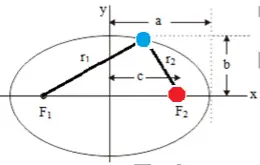 F1 kaj F2 estas elipsaj fokusoj. La suno estas ĉe unu el la fokusoj (ekzemple en la elektita bildo F2), la planedo estas je distanco de r2 de F2 aŭ r1 de F1Se la pozicio de la planedo ŝanĝiĝas, r2 kaj r1 ankaŭ ŝanĝiĝi.
Tamen, r₁ + r₂ ĉiam estas la sama. La distanco a nomiĝas la granda duonakso kaj 2a nomiĝas la granda akso. La distanco b nomiĝas la malgranda duonakso kaj 2b nomiĝas la malgranda akso. La fokuso de la elipso situas je distanco c de la centro de la elipso, kie c₂ = a₂ + b₂.
La formo de la elipso estas determinita de la ekscentreco (e) de la elipso, kie e = c / a. La ekscentreco de elipso varias de 0 ĝis 1 (0
Se la planedo estas ĉe la maldekstra fino de la elipso (maldekstre de F1 ) , tiam la distanco de la planedo al la suno estas a + c. Ĉi tiu punkto nomiĝas afelio. Kiam la planedo estas ĉe afelio, la planedo estas je sia plej fora distanco de la suno. Se la planedo estas ĉe la dekstra fino de la elipso (dekstre de F2 ) , tiam la distanco de la planedo al la suno estas ac. Ĉi tiu punkto nomiĝas perihelio. Kiam la planedo estas ĉe la punkto de perihelio, la planedo estas je la plej proksima distanco de la suno.
La dua leĝo de Kepler
La imaga linio, kiu estas desegnita de la suno ĝis la planedo, balaas egalajn areojn, dum la sama tempintervalo.
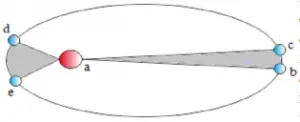 En la suba figuro, estas nur du ekzemploj de areoj, nome la areo abc kaj la areo ade. Ĉi tiuj du areoj havas la saman grandecon. Dum la sama tempointervalo, la imaga linio konektanta la planedon kaj la sunon balaas la areon, kiu havas la saman magnitudon. Do, moviĝante de b al c (la planedo estas ĉe afelio), la rapido de la pli malgranda planedo aŭ planedo moviĝas pli malrapide. Male, moviĝante de d al e (la planedo estas ĉe perihelio), la rapido de la pli granda planedo aŭ planedo moviĝas pli rapide. Do, la maksimuma planeda rapido estas kiam ĝi estas ĉe la periheliopunkto kaj la minimuma planeda rapido kiam ĝi estas ĉe la afeliopunkto.
La tria leĝo de Kepler
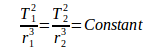
La proporcio de la kvadratoj de la orbital periodo de planedo al la kubo de the averaĝaj distancoj de la planedo kun la suno (T2/r3) estas konstanta, kaj la valoro estas la sama por ĉiuj planedoj. Se T1 kaj T2 deklaru la periodon de du planedoj, r1 kaj r2 reprezentas la averaĝan distancon de ĉiu planedo de la suno: