Prublemi risolti in e lege di u muvimentu di Newton - Forza di l'attritu staticu è cineticu
1. Un ughjettu riposa nantu à un pianu urizzuntale. U coefficientu di attritu staticu hè 0.4 è l'accelerazione di gravità hè 9.8 m/s² . Determinate (a) A forza massima di l'attritu staticu (b) A forza minima di F

Vergogna à tè
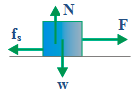
Cunnisciutu:
Massa (m) = 1 kg
U coefficientu di attritu staticu (μ s ) = 0.4
L'accelerazione di gravità (g) = 9.8 m/ s²
Pesu (w) = mg = (1 kg)(10 m/s² ) = 10 kg m/s² = 10 Newton
Forza nurmale (N) = w = 10 Newton
Cercatu:
(a) A forza massima di l'attritu staticu (b) A forza minima di F
Soluzione:
(a) A forza massima di l'attritu staticu
f s = μ s N
f s = (0.4)(9.8 N) = 3.92 Newtoni
(b) A forza minima di F
Sè a forza F hè esercitata nantu à l'ughjettu ma l'ughjettu ùn hè micca mossu, dunque ci deve esse a forza di attritu staticu esercitata da u pianu nantu à l'ughjettu. Sè l'ughjettu cumencia à movesi, a forza di l'attritu staticu hè superata, ci deve esse a forza di l'attritu cineticu. L'ughjettu cumencia à movesi sè F hè più grande di a forza massima di l'attritu staticu.
Cusì a forza minima di F = forza massima di l'attritu staticu = 3.92 Newton.
[irp]
2. Una scatula di 1 kg hè tirata longu una superficia urizzuntale da una forza F, dunque a scatula si move à una velocità costante. Sè u coefficientu di attritu cineticu hè 0.1, determinate a magnitudine di a forza F! (g = 9.8 m/ s² )

Cunnisciutu:
U coefficientu di attritu cineticu ( μk ) = 0.1
Massa di a scatula (m) = 1 kg
Accelerazione di gravità (g) = 9.8 m/ s²
Pesu (w) = mg = (1 kg)(9.8 m/s² ) = 9.8 kg m/s² = 9.8 Newton
Forza nurmale (N) = w = 9.8 Newton
Cercasi : F
Soluzione:
A prima lege di Newton dice chì s'è nisuna forza netta ùn agisce nantu à un ughjettu, ogni ughjettu cuntinueghja in u so statu di riposu, o velocità custante in linea retta.
Cusì, s'è l'ughjettu si move à una velocità custante , ùn ci deve esse nisuna forza netta ( Σ F = 0) . A forza F hè esercitata nantu à l'ughjettu in a direzzione dritta in modu chì a forza di l'attritu cineticu hè esercitata nantu à l'ughjettu in a direzzione manca.
∑ F = 0
F – fk = 0
F = fk
A forza di attritu cineticu:
f k = μ k N = (0.1)(9.8 N) = 0.98 Newton
l'ughjettu si move cù una velocità costante, F = f k = 0.98 Newton
[irp]
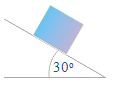
3. Un ughjettu scivola longu un pianu inclinatu cù una velocità costante. Determinate u coefficientu di attritu cineticu ( μk ) . g = 9.8 m/ s²
Vergogna à tè
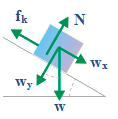
w = pesu, w x = cumpunente urizzuntale di u pesu, punti longu à l'inclinazione, w y = cumpunente verticale di u pesu, perpendiculare à u pianu inclinatu, N = forza nurmale, f k = a forza di l'attritu cineticu.
Cunnisciutu:
Massa (m) = 1 kg
Accelerazione di gravità (g) = 9.8 m/ s²
pesu (w) = mg = (1 kg)(9.8 m/s² ) = 9.8 kg m/s² = 9.8 Newton
w x = w sin 30 o = (9.8 N)(0.5) = 4.9 Newton
w y = w cos 30 o = (9.8 N)(0.5) √ 3 = 4.9 √ 3 Newton
Forza nurmale (N) = w y = 4.9 √ 3 Newton
Ricercatu : coefficiente di attritu cineticu ( μk )
Soluzione:
Un ughjettu scivola longu un pianu inclinatu cù una velocità costante in modu chì a forza netta = 0.
∑ F = 0
w x – f k = 0
w x = f k
w x = μ k N
5 = μk ( 5 √ 3 )
μ k = 5 / 5 √ 3
μ k = 1 / √ 3
μ k = 0.58
[irp]
[wpdm_package id='472′]
- Massa è pesu
- Forza nurmale
- A seconda lege di u muvimentu di Newton
- Forza di attritu
- Muvimentu nantu à una superficia urizzuntale senza forza di attritu
- Muvimentu di dui corpi cù a listessa accelerazione nantu à una superficia horizontale rugosa cù forza di attritu
- Muvimentu nantu à un pianu inclinatu senza forza di attritu
- Muvimentu nantu à un pianu inclinatu ruvidu cù forza di attritu
- Muvimentu in un ascensore
- Muvimentu di corpi cunnessi da corde è pulegge
- Dui corpi cù a listessa magnitudine d'accelerazione
- Arrotondamentu di una curva piatta - dinamica di u muvimentu circulare
- Arrotondamentu di una curva inclinata - dinamica di u muvimentu circulare
- Muvimentu uniforme in un cerchju urizzuntale
- Forza centripeta in un muvimentu circulare uniforme
