Konsepto sa mga Balod nga Elektromagnetiko

Concept of Electromagnetic Waves: A Journey Through Space and Time Electromagnetic waves have been fundamental to our understanding of the universe and our everyday technological advancements. From ancient speculative theories to the sophisticated scientific paradigm of today, the concept of electromagnetic waves has undergone substantial evolution. This article delves into the genesis, properties, applications, and … Basaha ang dugang pa

Relasyon Tali sa Misa ug Timbang

# The Relationship Between Mass and Weight: An Intricate Dance in Physics Understanding the concepts of mass and weight lies at the heart of physics and our interpretation of the physical world. Despite their frequent interchangeability in everyday language, mass and weight are distinct entities with unique characteristics. This article delves into the intricacies of … Basaha ang dugang pa

Unsaon Pagkalkulo sa Potensyal nga Enerhiya

How to Calculate Potential Energy Potential energy (PE) is one of the fundamental concepts in physics. It describes the energy possessed by an object due to its position, composition, or condition. There are various forms of potential energy including gravitational potential energy, elastic potential energy, and chemical potential energy. Understanding how to calculate potential energy … Basaha ang dugang pa

Kalainan Tali sa mga Skalar ug mga Vector sa Pisika

Difference Between Scalar and Vector in Physics In the realm of physics, understanding the fundamental concepts of scalar and vector quantities is crucial to the accurate analysis and description of physical phenomena. These two types of quantities form the bedrock upon which various principles and laws of physics are built. This article delves into the … Basaha ang dugang pa

Pagpasabot sa Teorya sa Relativity ni Einstein

Explanation of Einstein’s Theory of Relativity Albert Einstein’s theories of relativity, comprising the Special Theory of Relativity (1905) and General Theory of Relativity (1915), revolutionized our understanding of space, time, and gravity. These theories are pillars of modern physics, influencing various fields from cosmology to quantum mechanics. In this article, we explore these theories’ fundamentals, … Basaha ang dugang pa

Mga Ehemplo sa Uniform Linear Motion Problems

# Examples of Uniform Linear Motion Problems Uniform linear motion, also known as uniform rectilinear motion, refers to the movement of an object at a constant speed along a straight path. This type of motion is characterized by a constant velocity, implying there is no acceleration. In various fields such as physics, engineering, and everyday … Basaha ang dugang pa

Pagsabot sa Unang Balaod ni Newton

Understanding Newton’s First Law Sir Isaac Newton’s contributions to science were groundbreaking, and his First Law of Motion, often referred to as the Law of Inertia, stands as one of the most fundamental principles in physics. This law establishes the foundation for classical mechanics and helps us understand the behavior of objects in motion or … Basaha ang dugang pa

Ekwasyon sa grabidad

3 ka pangutana bahin sa ekwasyon sa grabidad

1. Tulo ka partikulo nga ang matag usa adunay gibug-aton nga 1 kg ang anaa sa mga tumoy sa usa ka equilateral triangle nga ang mga kilid niini 1 m ang gitas-on. Unsa ka dako ang puwersa sa grabidad nga nasinati sa matag punto nga partikulo (sa G)?

solusyonEkwasyon sa grabidad 1
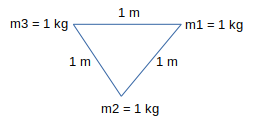
Ang gidak-on sa puwersa sa grabidad nga nasinati sa usa sa mga partikulo.

F12 = G (m1)(m2) / r2 = G (1)(1) / 12 = G/1 = G

F13 = G (m1)(m3) / r2 = G (1)(1) / 12 = G/1 = G

Resulta nga puwersa sa grabidad sa punto 1:

Basaha ang dugang pa

Ekwasyon sa natad sa kuryente

3 ka pangutana bahin sa mga ekwasyon sa electric field

1. Ang usa ka bola nga nag-conduct og kuryente nga may radius nga 10 cm adunay karga sa kuryente nga 500 μC. Ang mga punto A, B, ug C nahimutang sa linya sa sentro sa bola sa gilay-on nga 12 cm, 10 cm ug 8 cm matag usa gikan sa sentro sa bola. Kwentaha ang kusog sa electric field sa mga punto A, B, ug C!

Nailhan:Ekwasyon sa natad sa kuryente 1

Ang radius sa nag-conduct nga bola (R) = 10 cm = 0.1 m

Karga sa kuryente (q) = 500 μC = 500 x 10-6 C

rA = 12 sentimetros = 0,12 metros

rB = 10 sentimetros = 0,1 metros

rC = 8 sentimetros = 0,08 metros

Konstante sa Coulomb (k) = 9 x 10⁹

Nangita: Ang kusog sa electric field sa punto A (E)A), sa punto B (EB) ug sa punto C (EC)

solusyon:

Basaha ang dugang pa

Ekwasyon sa kanunay nga tingpamulak

3 ka pangutana bahin sa ekwasyon sa Spring constant

1. Ang usa ka spring nga nagbitay nga walay lihok (free suspension) adunay gitas-on nga 10 cm. Sa libre nga tumoy, usa ka 200 gramo nga pabug-at ang gibitay aron ang gitas-on sa spring kay 11 cm. Kon ang g = 10 m/s2, unsa ang spring force constant?

Nailhan:

Ang inisyal nga gitas-on sa spring (y1) = 10 cm = 0.10 m

Ang katapusang gitas-on sa spring (y2) = 11 cm = 0.11 m

Pagbag-o sa gitas-on sa spring (Δy) = 0.11 – 0.10 = 0.01 metros

Ang masa sa karga (m) = 200 gramos = 0.2 kg

Timbang sa karga (w) = mg = (0,2)(10) = 2 Newtons

Nangita: Kanunay nga spring (k)

solusyon:

Basaha ang dugang pa