Artikulo bahin sa Gravitational field ug kusog sa gravitational field
Kon imong itulod ang libro sa lamesa hangtod molihok ang libro, ang imong kamot mohikap sa libro. Ingon man usab, kon imong ihigot ang usa ka butang gamit ang pisi, dayon birahon kini hangtod molihok, ang imong kamot mohikap sa pisi, ang pisi mohikap sa butang. Niini nga kaso, ang kusog sa pagduso, kusog sa pagbira, kusog sa tensyon sa pisi, ug mga kusog nga sama niini gitawag nga kusog sa paghikap o kusog sa pagkontak. Ang kusog sa grabidad sa Yuta nga mobira sa prutas nga mahulog padulong sa nawong sa yuta. O, ang kusog sa grabidad sa yuta nga mobira sa bulan ngadto sa orbito sa yuta mahitabo nga walay paghikap tali sa yuta ug sa prutas ug bulan.
Busa, ang mga pwersa sa grabidad o mga pwersa nga sama niini gitawag nga mga pwersa nga dili makahikap. Giunsa man nga ang prutas mahulog ug ang bulan "mahulog" padulong sa yuta nga wala maghikap taliwala sa yuta ug prutas ug bulan? Ang mga siyentista, lakip si Newton , naglisod sa paghanduraw sa konsepto sa pwersa nga dili makahikap. Aron mas dali nga mahanduraw ug masabtan ang konsepto sa pwersa nga dili makahikap, gipataas ang konsepto sa natad.
Natad sa grabidad
Kon ang usa ka butang nga may masa naa sa kawanangan, ang butang mopatunghag gravitational field. Ang gravitational field sa usa ka butang nga may masa nga m gipakita sa porma sa mga linya sa field, sama sa gipakita sa hulagway sa ubos.
Kon mas layo gikan sa nawong sa butang, mas layo ang distansya tali sa mga linya sa gravitational field. Hinuon, kon mas duol sa nawong sa butang, mas magkaduol ang distansya tali sa mga linya sa field. Kon mas duol, mas dako ang kusog sa gravitational field. Kon mas layo, mas mogamay ang gravitational field. Ingon man usab, kon mas dako ang masa sa mga butang, mas moduol ang mga linya sa gravitational field. Kon ang usa ka test particle ibutang duol sa usa ka butang nga nagpatunghag gravitational field, ang test particle makasinati og gravitational force. Ang direksyon sa gravitational force padulong sa sentro sa butang nagpatunghag gravitational field.
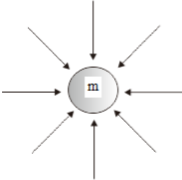 Kon mas layo gikan sa nawong sa butang, mas layo ang distansya tali sa mga linya sa gravitational field. Hinuon, kon mas duol sa nawong sa butang, mas magkaduol ang distansya tali sa mga linya sa field. Kon mas duol, mas dako ang kusog sa gravitational field. Kon mas layo, mas mogamay ang gravitational field. Ingon man usab, kon mas dako ang masa sa usa ka butang, mas modako ug moduol ang mga linya sa gravitational field.
Kon ang usa ka test particle ibutang duol sa usa ka butang nga nagpatunghag gravitational field, ang test particle makasinati og gravitational force. Ang direksyon sa gravitational force padulong sa sentro sa butang nagpatunghag gravitational field.
Kusog sa natad sa grabidad
Ang kusog sa grabidad sa yuta nga nasinati sa usa ka butang sa ibabaw sa nawong sa yuta:
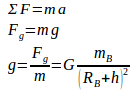
g = kusog sa natad sa grabidad
F g = puwersa sa grabidad
m B = masa sa yuta
R B = radius sa yuta = 6.37 x 10 6 m
h = gitas-on sa mga butang ibabaw sa nawong sa yuta
Kon gusto natong kuwentahon ang kusog sa grabidad sa usa ka planeta, ang masa, ug radius sa yuta (mB ug RB) gipulihan sa masa ug radius sa bulan o sa masa ug radius sa usa ka partikular nga planeta.
Kon atong tan-awon ang free-fall motion sa usa ka butang ibabaw sa nawong sa yuta, nan kini makita isip ang gravitational acceleration sa yuta nga nasinati sa butang, nga 9.8 m/s² . Kon ang butang anaa pa sa ibabaw sa nawong sa yuta (ang mga butang dili mahulog nga gawasnon), nan ang g makita isip ang gravitational field strength sa yuta nga nasinati sa butang, nga 9.8 N/kg.
